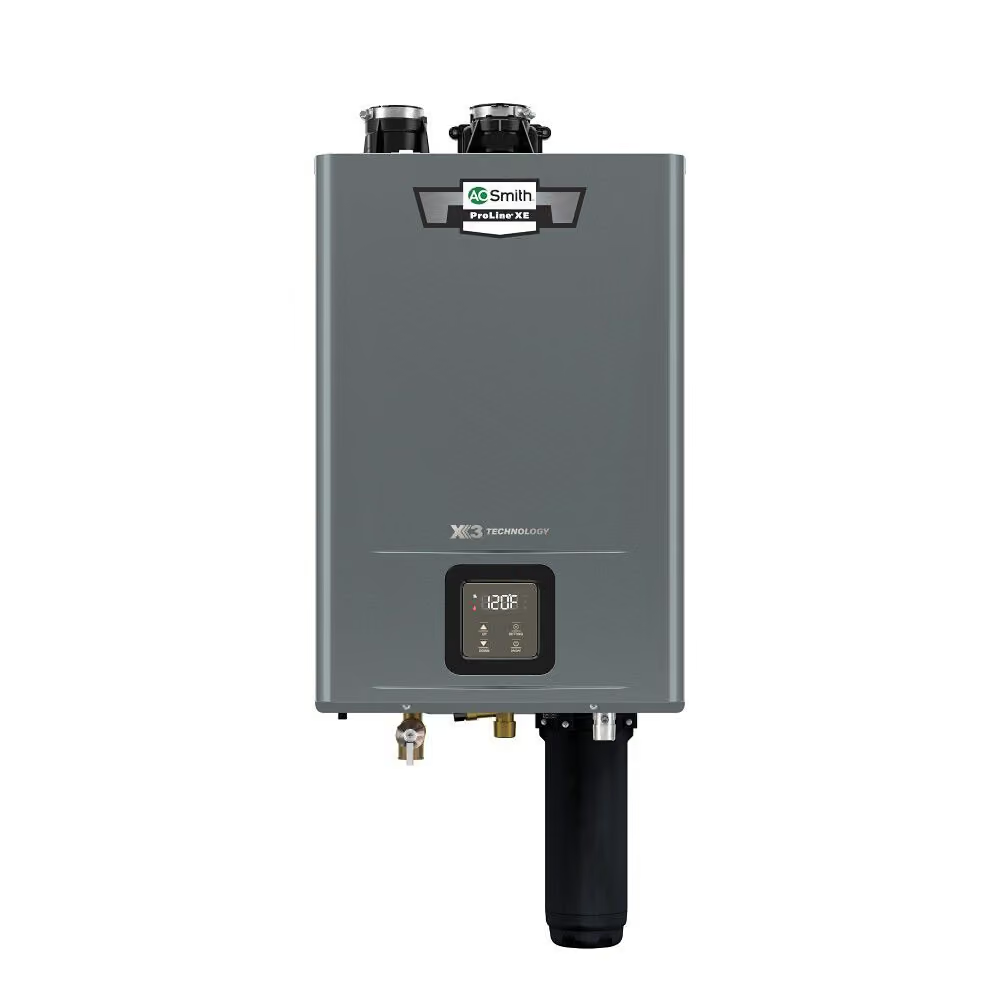
Who makes A.O. Smith
A.O. Smith was founded in 1874 in Milwaukee, Wisconsin, where it is still headquartered, and its water heater history goes back to the glass tank lining it introduced in 1933. Tankless is the newer chapter. In 2010, A.O. Smith formed a joint venture with Japan’s Takagi to market and manufacture tankless water heaters in North America, and agreed to take charge of the Takagi brand across the US and Canada. In January 2024 it launched Adapt with the models now sold as Adapt+, which it called the first tankless water heater designed and manufactured entirely by A.O. Smith. Adapt SC and Adapt NC followed in 2025. On its own tankless page, A.O. Smith calls itself an emerging tankless water heater manufacturer.
What sets A.O. Smith apart
X3 scale prevention
Scale is the mineral buildup hard water leaves inside a heat exchanger. A.O. Smith’s answer, introduced in 2022, is X3 Scale Prevention Technology: a cartridge on the cold-water inlet that it says stops minerals from bonding and forming scale. It also says X3 works especially well in homes with hard water. X3 models have the cartridge built in. Bypass models, marked with an M in the model number, use a bypass cartridge that can be swapped for an optional X3 cartridge later. A.O. Smith’s Adapt SC page lays out both versions.
Three heat exchanger designs
Adapt SC pairs a copper primary heat exchanger with a stainless steel secondary, where A.O. Smith says all condensing happens. Adapt+ uses one patented heavy-duty stainless steel heat exchanger, welded at only two points, and no secondary. Adapt NC uses a single non-condensing copper heat exchanger.
A pump built into Adapt+
Adapt+ has a recirculation pump built in, which A.O. Smith says helps deliver hot water quickly. It needs a dedicated return line or a crossover valve at the fixture farthest from the heater. The display lets you review up to two recirculation schedules, and A.O. Smith lists an optional Wi-Fi module kit. Adapt SC has no pump inside but is approved for use with an external recirculation pump.
Which A.O. Smith fits a Houston home
Flow comes first. A.O. Smith rates the ATM-199X3-N, a 199,000 BTU/h Adapt SC, at up to 10.5 GPM, and at 6 GPM when it has to raise the water temperature by 67°F. The less the heater has to warm the incoming water, the more hot water it can deliver. Incoming water in Houston averages about 67°F and shifts with the seasons, so the right size comes from how many showers, tubs and appliances run together in your home.
Next, choose condensing or not. Both Adapt SC and Adapt+ are condensing heaters rated 0.95 UEF, while the non-condensing Adapt NC is rated up to 0.82 UEF, and A.O. Smith notes that non-condensing heaters generally need metal exhaust venting to withstand higher temperatures. Replacing a tank heater? Our tank-to-tankless planning guide walks through the conversion.
Electric is the other route, with no venting at all, but the large models draw serious current: A.O. Smith’s listing for the 32 kW R4MA-320E calls for 133 amps and #6 AWG wire, so your electrical panel matters as much as your plumbing. Point-of-use models serve single fixtures, and A.O. Smith says they are not designed for showers.
Strengths and trade-offs
Where A.O. Smith stands out
- A.O. Smith says X3 can extend a water heater’s life by up to 300%.
- Every Adapt SC model is rated 0.95 UEF and ENERGY STAR certified.
- Adapt+ combines a built-in pump with field conversion from natural gas to propane.
- The original Adapt with X3, now sold as Adapt+, won a 2025 Silver Edison Award in the Sustainable Consumer Products category.
What to weigh
- Adapt is young. Adapt+ arrived in 2024 and Adapt SC and Adapt NC in 2025, so their track record in homes is short.
- A.O. Smith says the ATM-199X3-N can save up to $116 a year in operating costs against a 50-gallon atmospheric tank. On energy savings alone, a tankless upgrade typically takes 12 to 20+ years to pay back.
- The Signature Series is a separate retail line with its own GT model numbers, so judge those heaters on their own specifications.
A.O. Smith’s warranty, in plain English
Adapt SC and Adapt+ carry a 15-year limited warranty on the heat exchanger and a 5-year limited warranty on parts in residential use, for X3 and M versions alike. Adapt NC gives X3 models 15 years on the heat exchanger and base models 10. ProLine Electric carries a 5-year limited warranty; for the R4MA-320E, A.O. Smith’s listing specifies 5 years on the heating chambers and 1 year on parts.
A.O. Smith says its X3 models carry no scale exclusions, and its manuals say freeze damage is not covered. For labor and any registration or installer conditions, read the warranty sheet for your exact model, and ask us to go through it with you. Already own an A.O. Smith? Check its coverage by serial number on the warranty verification page.
Installing an A.O. Smith in Houston
Four connections shape an Adapt installation. Gas: Adapt SC is listed for a 3/4-inch line and Adapt+ for 1/2-inch or 3/4-inch, and we check the line’s capacity before we quote. Venting: the ATM-199X3-N runs up to 50 feet in 2-inch PVC or 150 feet in 3-inch, with ABS, CPVC and polypropylene also approved, and Adapt+ stretches 2-inch runs to 75 feet. Condensate: condensing models need a drain. Power: 120 volts at 5 amps. The ATM-199X3-N also stands 40.41 inches tall, so we confirm the wall space early.
Outdoors, Adapt SC and Adapt+ need A.O. Smith’s outdoor vent cap kit, while Adapt NC comes as separate outdoor ATO models. Permits are the plumber’s job: whoever pulls one in Texas must be a licensed master plumber serving as the Responsible Master Plumber, and for a Houston address that plumber also needs a City registration. Our guide to Houston water heater permits covers the rest. For budgeting, we publish a $4,200 to $8,000 range for tankless equipment and installation, and our tankless installation page shows what pushes a job toward either end. Replacing an existing tankless typically takes 4 to 6 hours; see our guides to installation timing and tankless venting.
Repairs and maintenance
For X3 models, A.O. Smith says regular scale-related maintenance is not needed. For M models still on the bypass cartridge and base Adapt NC models, it says regular descaling is required, and it calls for routine descaling on its electric models too. Houston’s supply averages about 8 grains per gallon, which counts as hard on the USGS scale, and A.O. Smith’s own product guide treats anything above 3 grains per gallon as generally hard.
Condensing models also have a condensate system to keep clear, and A.O. Smith’s Adapt+ service videos include a condensate cleanout. For models that need descaling, our tankless maintenance visit is a flat $195 a year and includes professional descaling, a 12-point check and a written report. When an Adapt shows an error code on its display or the hot water stops, our tankless repair technicians find the cause before replacing anything, and most tankless repairs run $150 to $600.