CONDENSING GAS
T-H3
Four sizes, indoor and outdoor.
T-H3M, T-H3J, T-H3S and T-H3 span 120,000 to 199,000 BTU/h and 6.6 to 10 GPM, rated 0.90 to 0.95 UEF. Takagi says the T-H3M can use an existing 1/2-inch gas line and PVC venting.

Takagi’s T-H3 is a condensing gas heater in four sizes, up to 199,000 BTU/h and 10 GPM, with separate indoor and outdoor models. We’ll match the size to how your household uses hot water.
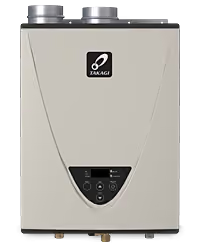
Three choices separate Takagi’s four families: condensing or not, X3 scale prevention or not, and a recirculation pump inside or not.
CONDENSING GAS
T-H3M, T-H3J, T-H3S and T-H3 span 120,000 to 199,000 BTU/h and 6.6 to 10 GPM, rated 0.90 to 0.95 UEF. Takagi says the T-H3M can use an existing 1/2-inch gas line and PVC venting.
CONDENSING + SCALE PREVENTION
Three sizes, TK-240X3 to TK-540X3, from 6.6 to 10 GPM. No annual descaling is required, Takagi says, and the 15-year heat exchanger warranty covers scale-related failures.
CONDENSING GAS + PUMP
One 199,000 BTU/h, 10 GPM size with the pump inside, for a home with a dedicated recirculation line. The indoor TK-540P is rated 0.93 UEF; the outdoor model is 0.95 and ENERGY STAR certified.
Each model is built for indoor use or for outdoor use, and ratings vary by size and location. Your quote names the exact heater and the ratings that apply.
Takagi has made tankless water heaters since 1952, and the brand sells nothing else. It comes from Takagi Industrial Co. Ltd. of Shizuoka, Japan. A.O. Smith has run the Takagi brand in the US and Canada since a 2010 joint venture with Takagi Industrial.
Takagi lists 46 models, 36 condensing and 10 non-condensing. All run on natural gas or propane, all are Ultra-Low NOx, and 16 are ENERGY STAR certified. Each is built for either indoor or outdoor installation, and there is no electric Takagi.
Hard water leaves scale inside a heat exchanger, and Takagi calls it a leading cause of failure for tankless water heaters. X3 Scale Prevention Technology is its answer: water heating and treatment combined in one unit. Takagi says X3 models are designed to last three times longer than tankless models without X3 and need no annual descaling. X3 is on 14 of the 46 models: the TK-240X3, TK-340X3 and TK-540X3 in indoor, outdoor, natural gas and propane versions, plus two non-condensing concentric-vent models, the TK-310CX3 and TK-510CX3.
The T-H3 heats water in two stages. Its primary heat exchanger is a commercial-grade copper alloy, which Takagi says transfers heat 25 times better than stainless steel. The secondary is 316L stainless steel, where acidic condensate forms, and Takagi sells a neutralizer kit to treat it. Takagi aims the T-H3 at heavier residential use, such as homes with recirculation, and at light commercial jobs such as small restaurants and beauty salons, which our commercial tankless service covers.
The TK-540P builds a recirculation pump into a 199,000 BTU/h condensing heater, which Takagi says provides instant hot water in homes with dedicated recirculation lines. Takagi lists the pump’s reach as 100 feet of 1/2-inch pipe or 500 feet of 3/4-inch pipe.
Start with your water. Takagi’s T-H3 manual says hardness must not exceed 7 grains per gallon in a single-family home, and the City of Houston’s 2025 water quality report puts the main system at about 8 grains per gallon, inside the USGS’s hard category. Takagi handles scale two ways: X3 models, or a water softener or treatment device on a standard model, which its FAQ recommends. Even with treatment, the T-H3 manuals exclude scale damage, so regular flushing still matters.
Next, size for flow. T-H3 and X3 sizes run from 6.6 to 10 GPM, with the top figure on the 199,000 BTU/h models. Takagi states no temperature rise for that maximum and notes that capacity depends on ground water temperature, which averages about 67°F in Houston. We count the showers and appliances that run together at your busiest hour and size the heater to that peak.
Then choose condensing or not. The T-H3, the TK-240X3 to TK-540X3 and the TK-540P are condensing, rated 0.90 to 0.95 UEF. Indoor versions of the non-condensing TK-110U, TK-310U and TK-510U need Category III stainless steel venting, and the indoor TK-110U and TK-510U are rated 0.81 UEF. They are also lighter, at 39 and 40 pounds, against 59 to 73 pounds for the indoor 199,000 BTU/h condensing models.
Last, decide on recirculation. The TK-540P has its pump built in. A T-H3 works with an external pump and a pump control such as an aquastat or timer, and the TK-240X3 to TK-540X3 are approved for an external pump with a cross-over valve.
Every residential Takagi carries a 15-year limited heat exchanger warranty and 5 years on the other parts, except fuses. Labor is covered for 1 year under the X3 and TK-540P terms. Commercial use carries shorter terms that vary by model.
Takagi attaches conditions to those years. It calls for installation and service by a licensed plumber, licensed gas fitter or professional service technician; installation by an unqualified person, or one that ignores Takagi’s installation requirements, can void the warranty. Under the T-H3 manuals, scale damage is excluded and the hardness limit above applies, while X3 coverage includes scale-related failures. And if a T-H3 runs an external recirculation pump without a proper pump control, heat exchanger and parts coverage drops to 3 years.
Takagi’s product pages encourage you to register online to benefit from its full warranty and support, and its warranty page links the current terms.
On a T-H3-DV-N, gas and water connect at 3/4 inch. Takagi notes that its more powerful models usually need a larger gas line than a tank, so we check your line against the piping chart in the installation manual before we quote. The 4-inch vent runs in Schedule 40 PVC, CPVC, polypropylene or Category III stainless steel, and Takagi does not allow common venting with any other appliance. Power is 120 volts at under 2 amps with a means of disconnection, and a pressure-only relief valve must be installed to code.
In Texas, the Responsible Master Plumber pulls the permit for a Takagi install. That plumber must hold a master plumber license and, inside Houston, a City registration; our Houston permit guide explains more. As a planning figure, a new tankless heater and its installation cost $4,200 to $8,000 by our published pricing, and the tankless installation page lists what pushes a Takagi job up or down. Swapping one tankless for another typically takes 4 to 6 hours, and our tank-to-tankless guide covers replacing a tank.
Takagi’s FAQ says that in areas with exceptionally hard water the heat exchanger may need periodic flushing by a plumber, and its service handbook walks through a vinegar flush. A lower temperature setting also helps prevent scale, Takagi says, and for treatment it points to the Product Preservers Anti-Scale System, whose filter needs changing every 2 years. Every Takagi, X3 or not, needs the area around it kept free of dust and debris.
For a Takagi without X3 in Houston’s water, we recommend our tankless maintenance once a year. The flat $195 fee buys a professional descale of the heat exchanger, a 12-point check and a written report for your records. If a Takagi stops delivering hot water, our tankless repair technicians trace the fault before any part is replaced; most tankless repairs run $150 to $600.
Hot Water Guys installs, repairs and maintains Takagi tankless water heaters across Greater Houston, and Takagi says its heaters are sold only through plumbing wholesalers and contractors. Planning starts with your water hardness, gas line and vent route.
Houston’s main supply runs about 8 grains per gallon, above the 7-grain limit in Takagi’s T-H3 manual. Choose X3, or treat the water and plan regular flushing.
Takagi’s largest sizes reach 10 GPM, and capacity depends on ground water temperature. So we start from every fixture you run at once and the temperature you keep.
The T-H3-DV-N takes 3/4-inch gas and water connections. Its 4-inch vent can be PVC, CPVC, polypropylene or Category III stainless, serving no other appliance.
The TK-540P has a pump built in. A T-H3 can take an external pump, but without a proper pump control Takagi cuts heat exchanger and parts coverage to 3 years.
The T-H3-DV-N is built for indoor use only. Outdoors, Takagi’s matching model is the T-H3-OS-N: rated 0.95 UEF, ENERGY STAR certified and sold with a remote control. It mounts on a wall or a stand.
Takagi calls hard water scale a leading cause of tankless failure, so your care plan depends on whether your model has X3.
On models without X3, have the heat exchanger flushed to clear scale; Takagi’s service handbook uses vinegar. A lower temperature setting also slows buildup.
Takagi says X3 models need no annual descaling. Every model still needs a dust-free space around it, and an assessment if performance changes.
Residential use: the heat exchanger is covered for 15 years and other parts for 5, fuses excepted. X3 and TK-540P terms also include 1 year of labor.
Takagi’s T-H3 manuals cap water hardness at 7 grains per gallon and exclude scale damage. X3 models carry 15-year heat exchanger coverage that includes scale-related failures.
What to know about X3, sizing, fuel, controls, flushing, cost and coverage.
Both are condensing gas heaters, and the largest size of each reaches 199,000 BTU/h and 10 GPM. The TK-240X3, TK-340X3 and TK-540X3 add X3 scale prevention, and their 15-year heat exchanger coverage extends to scale-related failures. The T-H3 comes in four sizes, and its manual caps water hardness at 7 grains per gallon, which Houston’s average of about 8 exceeds.
Takagi describes the TK-540P-NEH as suited to a 4-bath home in southern climates or a 3-bath home in northern ones. Takagi’s largest models top out at 10 GPM, and the number of showers they can run depends on ground water temperature, about 67°F on average in Houston. We size around the fixtures you use at once.
Yes. T-H3 and TK-240X3 to TK-540X3 heaters come in separate natural gas and propane versions, and the TK-110U, TK-310U and TK-510U convert from natural gas to propane in the field. Each model is built for indoor or outdoor use, with no conversion kit between them, so an outdoor install calls for an outdoor model such as the T-H3-OS-N.
Takagi does not list a Wi-Fi module or app for its heaters. Outdoor T-H3 models include a remote control as standard, while the indoor T-H3-DV-N has none. If faster hot water at the tap matters more to you, the TK-540P’s built-in pump has multiple settings you can match to your routine.
Where water is exceptionally hard, Takagi says a plumber may need to flush the heat exchanger periodically. Houston’s main water system runs about 8 grains per gallon, hard by USGS standards, so we recommend a yearly flush for models without X3. X3 models, by Takagi’s account, need no annual descaling.
For a tankless heater plus installation, our published range is $4,200 to $8,000, a general guide rather than the price of a particular Takagi. Your gas line, vent route and any code updates move the total. Takagi says the T-H3M, the smallest T-H3, lowers installation costs by working with an existing 1/2-inch gas supply line and inexpensive PVC venting. Call 832-673-0909 for a free quote.
Residential coverage runs 15 years for the heat exchanger and 5 years for parts other than fuses. Installation by an unqualified person voids it, and the T-H3 manuals exclude scale damage. Running a T-H3 with an external pump but no proper pump control cuts heat exchanger and parts coverage to 3 years.
Tell us whether your home has a softener and what heats your water today. We’ll recommend a Takagi, X3 or standard, and plan the installation.