01
In-home consultation and test.
We test hardness, TDS (total dissolved solids), pH, chlorine and chloramine and iron, and send samples to a certified lab for PFAS and heavy metals when indicated.

Licensed, insured technicians with 1,400+ five-star reviews.
Houston’s municipal system treats water for safety but doesn’t treat it for quality. Chloramine, sediment, hard water minerals and, in some areas, PFAS pass through into your home every day. A whole-house system stops them at the main water line, before a single faucet, showerhead or appliance.
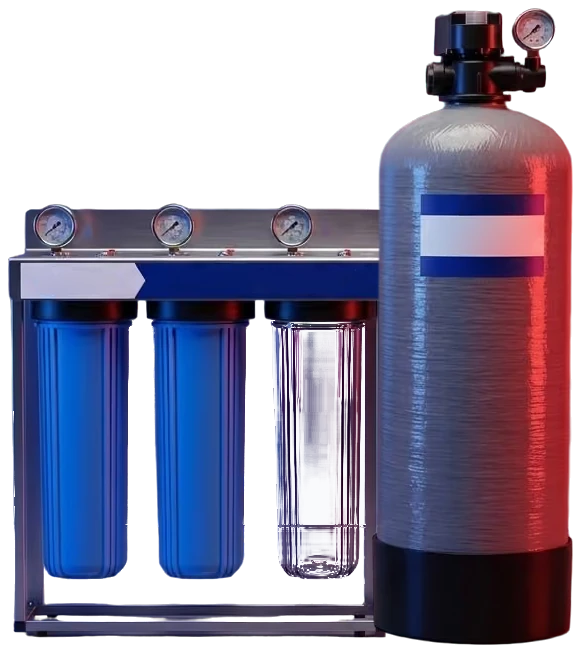
A point-of-use filter treats one faucet. A whole-house system treats every shower, bath, laundry load, dishwasher cycle and ice maker.
We’ve seen tankless water heaters that needed yearly descaling go 3+ years between maintenance after a softener-filtration combo went in.
Coffee, tea, soups, pasta and ice all taste better. Filtered water without chloramine gives noticeably cleaner, more natural flavors.
Homes on the west side near Katy and Sugar Land often deal with hard water from the Gulf Coast Aquifer. North Houston and The Woodlands see more sediment and iron. Areas closer to the Ship Channel may have higher PFAS and VOC levels. That’s why we test before we recommend anything.

Hard water is the most visible problem. The white, chalky deposits on showerheads, faucets and inside your tankless water heater are calcium and magnesium scale. City of Houston water averaged about 8 grains per gallon in the City’s 2025 water quality report, a level the USGS classifies as hard, and samples ran as high as about 13. Scale cuts water heater efficiency, clogs aerators, shortens appliance life and leaves skin and hair feeling dry after a shower.
This is the second most common complaint. Houston disinfects with chloramine, a combination of chlorine and ammonia. It’s less volatile than free chlorine, but many residents still notice a chemical taste in their drinking water and a bleach-like smell in hot showers. Standard pitcher filters with granular carbon don’t work against chloramine. You need catalytic carbon rated for chloramine reduction.
PFAS are the newest and most serious concern. The Environmental Working Group has detected PFAS in Houston-area water systems, and levels near the San Jacinto River waste pits have been particularly elevated. PFAS don’t break down in the environment or the human body. Long-term exposure has been associated with liver damage, thyroid disease, immune system effects and certain cancers.
The City of Houston draws its drinking water mainly from surface water, Lake Houston, Lake Livingston and the Trinity River, with supplemental groundwater from the Gulf Coast Aquifer. Treatment uses chloramine to disinfect the supply. It works, but it creates disinfection byproducts (DBPs), such as trihalomethanes and haloacetic acids, that stay in the water all the way to your tap.
The water picks up more on its way through miles of aging infrastructure. Pipe corrosion adds sediment and trace metals. Agricultural runoff contributes pesticide residues. Industrial activity near the Ship Channel and the petrochemical corridor has introduced PFAS (per- and polyfluoroalkyl substances), VOCs (volatile organic chemicals) and other industrial chemicals into the water table, and PFAS have been found near the San Jacinto River basin and in several Harris County water supplies.
Hardness also varies by district: one Fort Bend County MUD report from the Katy area shows 127 to 277 ppm, about 7 to 16 grains per gallon.
A whole-house system filters all the water entering your home at the main supply line, so every shower, bath, washing machine load, dishwasher cycle and ice maker uses treated water. For hard water scale on fixtures, chlorine-dried skin and hair, or concerns about contaminants in the municipal supply, it’s the most comprehensive solution available. The result is clean water from every tap, longer-lasting appliances and the peace of mind that your family’s water is safe.
Activated carbon is the workhorse of residential water treatment. It removes chlorine, chloramine, VOCs, pesticides and the chemical taste and odor that make Houston tap water unpleasant to drink. Our whole-house carbon systems use high-capacity catalytic coconut shell carbon rated for 600,000+ gallons, so most Houston families go 3 to 5 years between filter changes. They flow 10 to 15 GPM and are NSF/ANSI 42 certified. Carbon alone makes a dramatic difference to taste, shower comfort and appliance life.
For most Houston homes, the best solution pairs a water softener, which removes the calcium and magnesium behind scale, with a carbon filter, which removes chemicals and improves taste. Together they protect your tankless water heater from scale damage, end white residue on fixtures and soap scum buildup, and deliver soft, clean water to every tap. Our softeners use high-efficiency ion exchange resin with 32,000 to 64,000 grains of capacity, metered regeneration and a bypass valve, certified to NSF/ANSI 44. We size the grain capacity to your household and your water’s hardness.
For PFAS, we install granular activated carbon and ion-exchange systems certified to NSF/ANSI 53 and P473 for PFOA and PFOS removal.
The Express Water Ultimate Protection Whole House Filter (WH300SCKP) is built for high-flow filtration where water enters the home. Reverse osmosis systems filter down to the molecular level for drinking water. This system focuses on high-flow removal of the contaminants that affect your skin, hair and household appliances. It primarily targets:
Three cartridges each do one job: KDF (kinetic degradation fluxion) handles metals like lead and iron, a polyphosphate (PHO) filter sequesters minerals for anti-scale and corrosion protection, preventing hard water buildup in your pipes and extending the life of appliances like your dishwasher and laundry machine, and an activated carbon block (ACB) removes chemicals and polishes the taste and odor.
We install whole-house filtration across Greater Houston, including Houston, Katy, Cypress, Sugar Land, Spring, Tomball, The Woodlands, Conroe, Magnolia, Montgomery, Willis, Splendora, Cleveland, Bellaire, Missouri City, Richmond, Jersey Village and Brookshire, plus Fort Bend, Waller, Montgomery, Liberty, Brazoria and Galveston Counties. Not sure we serve your area? Call us. Chances are we do.
Priced after a water test
Free estimates after an in-home consultation, matched to your plumbing and your water concerns.
Your home’s plumbing configuration, your water concerns and which system fits best, from a single-stage carbon filter to a multi-stage softener and filtration combo or a specialty PFAS system. That’s why we price after an in-home consultation instead of selling one-size-fits-all filter boxes.
Equipment carries the manufacturer’s warranty, typically 5 to 10 years on tanks and 3 to 5 years on electronics. You also get our 90-day satisfaction guarantee: if you’re not happy with your water quality, we’ll make it right or remove the system for a full refund. Call 832-673-0909 to schedule.
Four steps, from an in-home water test to a retest at several fixtures once the system is running.
We test hardness, TDS (total dissolved solids), pH, chlorine and chloramine and iron, and send samples to a certified lab for PFAS and heavy metals when indicated.
We design around your results, water source, pipe size and family size, without over-engineering or overselling.
Usually 2 to 4 hours, at the main line after the meter and before any branch lines, with code-compliant fittings and a bypass valve.
We retest at several fixtures and walk you through filter changes, softener salt and the system’s diagnostic indicators.
Single-stage carbon filters, multi-stage softener and filtration combos and specialty contaminant systems, including the Express Water Ultimate Protection whole-house filter.
Every system is designed around your water test. The bypass valve lets us service it later without shutting off water to the house.
They solve different problems. A water softener removes the calcium and magnesium that cause scale. A filter removes chemicals, sediment and contaminants. Most Houston homes benefit from both, which is why we offer combo systems.
We’ll help you choose the right setup during the consultation, based on your water test and what you want the system to fix.
Confirm the service address and project with the team. Some areas are subject to an additional travel fee.
It depends on your home’s plumbing configuration, your water concerns and which system type fits best. We give free estimates after an in-home consultation, so the price reflects your situation. Call 832-673-0909 to schedule.
Houston tap water meets EPA minimum standards, but it contains chloramine, hard water minerals and, in some areas, detectable PFAS. It’s technically safe by federal standards, and many homeowners still choose filtration for better taste, less chemical exposure and appliance protection.
Depending on the configuration, chlorine, chloramine, sediment, VOCs, pesticides and hard water minerals (calcium and magnesium). With specialty media, it can also remove PFAS, lead and arsenic.
Most whole-house filtration installations take 2 to 4 hours, depending on the system’s complexity and your plumbing configuration. We install at the main water line before any branch lines, so your entire home is protected, and we include a bypass valve for easy maintenance later.
They solve different problems. A water softener removes the hard water minerals (calcium and magnesium) that cause scale. A filter removes chemicals, sediment and contaminants. Most Houston homes benefit from both, which is why we offer combo systems. We’ll help you choose the right setup during your consultation.
Greater Houston, including Houston, Katy, Cypress, Sugar Land, Spring, Tomball, The Woodlands, Conroe, Magnolia, Montgomery, Willis, Bellaire, Missouri City, Richmond, Jersey Village and the surrounding counties. See all of our service areas.
We test it first, then recommend a system that fits your plumbing and your concerns. Estimates are free.