Gas storage
A gas burner heats stored water. The assessment considers available gas supply, combustion-air and venting requirements, location, and model performance.

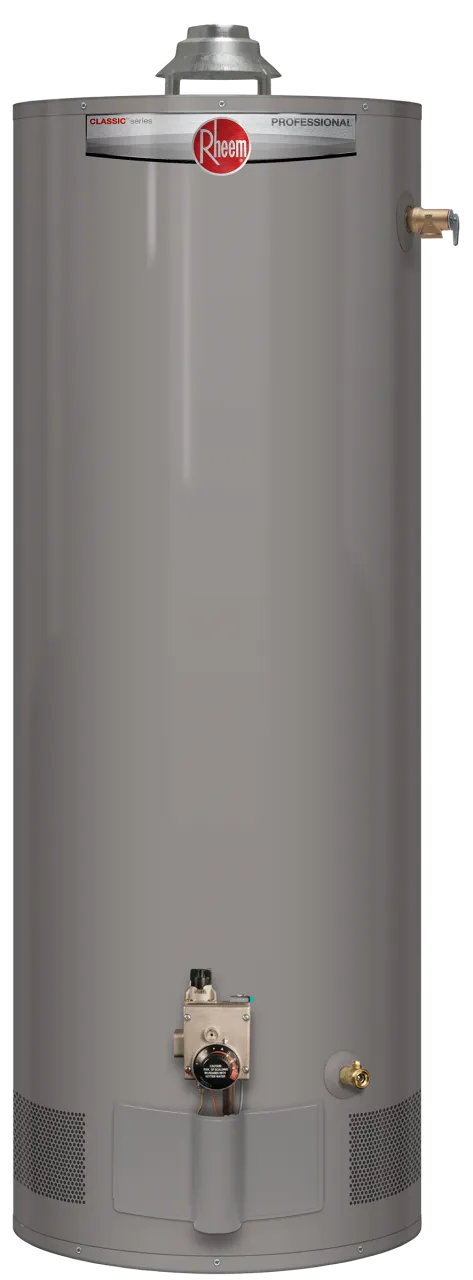
A stored supply of hot water, planned around your Houston home.
From the morning showers to the evening dishes, a storage heater needs to match the way your household uses water. We help you choose the tank and plan the installation around it.
Your home’s demand, fuel, and installation requirements guide the model selection.
The number on the tank tells you its nominal storage size. The first-hour rating tells a more useful story about delivery.
The heated supply available when that hour begins.
The heater’s contribution as water is used during the hour.
The model rating to compare with peak-hour demand.
A first-hour rating measures how much hot water a fully heated storage system can deliver over an hour. It includes storage and recovery; it is not simply the tank’s gallon label.
Tell us about the showers, baths, and appliances used in your busiest hour. Household size is useful context, but the actual demand and the model’s rating help determine a suitable choice.
Good selection brings demand, equipment, and the property together. Here is what we consider with you.
We look at showers, baths, and hot-water appliances that overlap. The chosen tank’s first-hour delivery and recovery should match that demand.
We review the available gas or electrical service and the model’s requirements. Fuel, efficiency, usage, and energy prices all affect running cost.
We account for the cylinder, required clearances, access during installation, and room for future service. A tank must fit the installation as well as the floor space.
We assess water connections, gas venting where applicable, power, drainage, and property-specific requirements. The quote should identify the work that is needed.
After installation, we check operation, explain the controls, and review care instructions and warranty documentation. Coverage follows the selected manufacturer’s terms.
A new installation can involve a different scope from replacing an existing tank. The equipment, location, available connections, and required work determine the quote.
Ask about tank options from Rheem, A.O. Smith, and Bradford White. Confirm the exact model and availability in your quote.
Keep the model details and follow the manufacturer’s maintenance guidance. Water conditions, sediment, and corrosion protection can affect service needs. Have changes in sound, color, or hot-water performance assessed rather than treating them as a diagnosis.
Warranty terms vary by model and application. Review parts, tank, and labor coverage separately, and keep the installation documents.
Capacity, fuel, pricing, and the installation scope.
We start with peak-hour hot-water demand and compare it with candidate models’ first-hour ratings and recovery. Household size is useful context, but nominal tank gallons alone do not show whether the system will meet your busiest hour.
Consider the home’s available services, installation conditions, household demand and the selected model’s running costs. Gas and conventional electric-resistance tanks have different requirements. Heat-pump storage is a separate option to assess; it should not be treated as the same technology as resistance storage.
A new installation needs a home-specific quote. The selected tank, fuel, location, new connections, and required work determine the price. Ask for an itemized scope. The published $2,500–$4,500 tank-replacement range covers a different project and should not be assumed for every new installation.
Confirm the chosen tank, its capacity and first-hour rating, installation work, applicable permits or inspections, testing and handover. Include removal only if an existing unit is part of the project. Ask how maintenance and manufacturer warranty documentation will be handled.
Tell us about the home, the available space, and the busiest part of your day. We’ll help you plan the next step.