CONDENSING GAS
SENSEI RX
One model, either fuel.
Four models from 7.1 to 11.1 GPM, rated up to 0.98 UEF. Each runs on natural gas or propane and goes outdoors with the Versa Vent cap. No pump inside, but recirculation capable.

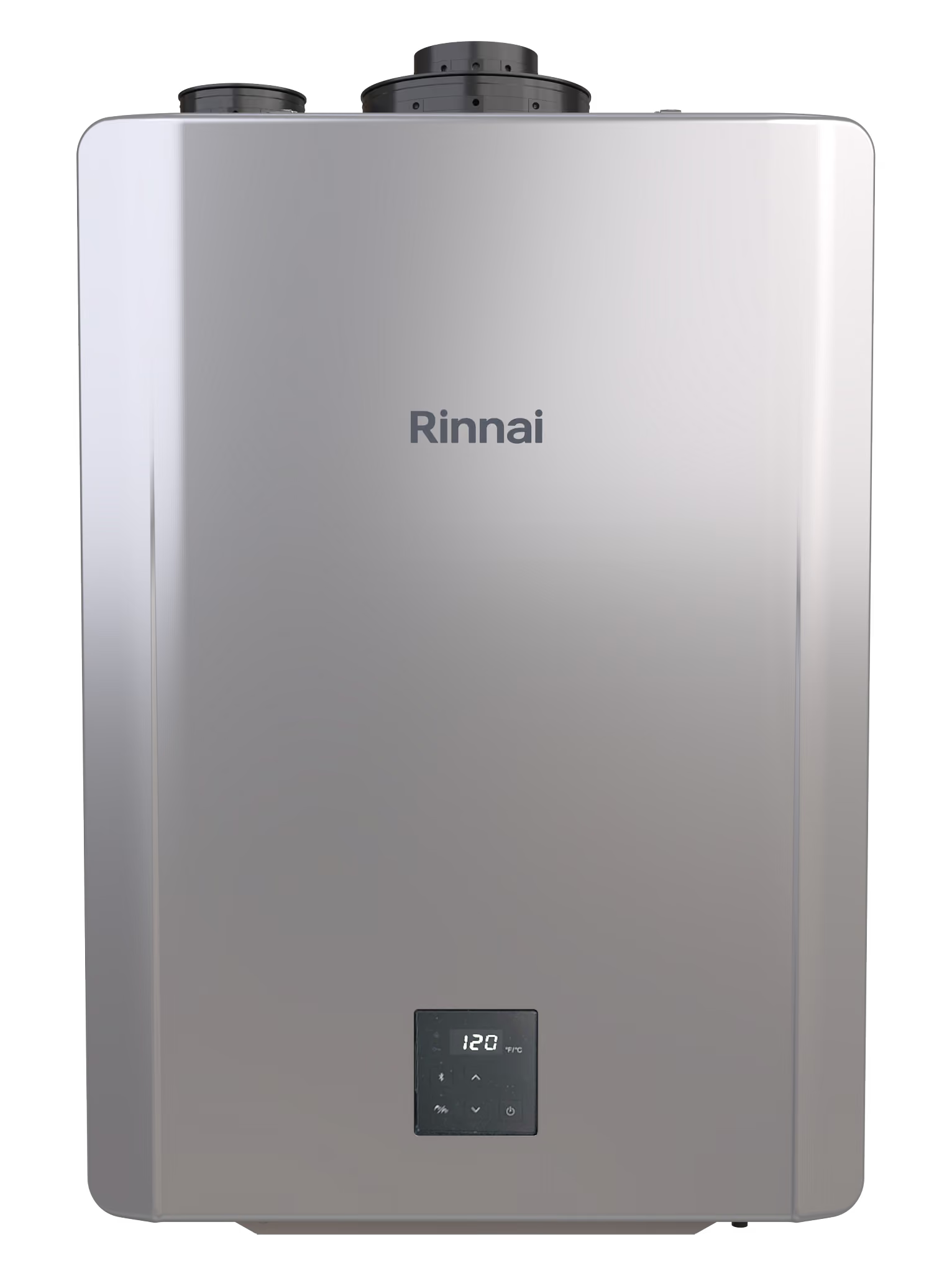
Rinnai has heated water since 1964. Its SENSEI RX runs on natural gas or propane, installs indoors or outdoors with a vent cap, and is rated up to 0.98 UEF. We’ll size the right one for your home.
Two questions sort Rinnai’s lineup: condensing or non-condensing, and a pump built in or not. Each family answers them differently.
CONDENSING GAS
Four models from 7.1 to 11.1 GPM, rated up to 0.98 UEF. Each runs on natural gas or propane and goes outdoors with the Versa Vent cap. No pump inside, but recirculation capable.
CONDENSING GAS + PUMP
RXP adds an internal pump and Smart-Circ, which learns your hot water use over seven days and schedules recirculation to match. No return line? A bypass valve at the farthest fixture closes the loop.
NON-CONDENSING GAS
Rinnai’s redesigned non-condensing line, assembled in Griffin, Georgia. Rated 0.81 to 0.82 UEF, with an LED screen for error codes and service reminders. Each model is built for one fuel and one location.
Ratings, fuel setup and indoor or outdoor fit vary by model. The exact heater in your quote decides which numbers apply.
Rinnai was founded in Japan in 1920, is headquartered in Nagoya and has been heating water since 1964. Its US company, Rinnai America, was established in 1974 and is based in Peachtree City, Georgia. In 2018 it assembled its first tankless water heater in the United States, in Griffin, Georgia, and its non-condensing RE models have been assembled there since 2022. Rinnai says more than 30 million of its tankless water heaters have been installed worldwide, over 2 million of them in North America, and that it makes most of its key components itself.
Every SENSEI RX and RXP model runs on natural gas or propane. Rinnai’s Smart Sense adaptive gas valve adjusts to the fuel with no conversion kit, and your installer sets the gas type during setup. The same models install indoors or, with the RXOVC Versa Vent cap sold separately, outdoors. That flexibility belongs to SENSEI: each RE and REP model is built for one fuel and one location.
RXP and REP models have a pump built in and use Smart-Circ, which learns how your household uses hot water over seven days and schedules recirculation around it. A home without a dedicated return line can still use it: a thermal bypass valve at the fixture farthest from the heater completes the loop. On REP models, Smart-Circ switches off when the Wi-Fi module is connected.
SENSEI models connect to the installer’s phone over Bluetooth for setup and product registration, with no Wi-Fi needed. For remote control of temperature, status and vacation mode, Rinnai sells the RWM200 Wi-Fi module separately.
Start with flow. Tankless capacity is quoted in gallons per minute, and the real number depends on how much the heater has to warm the water. Rinnai’s groundwater map puts Houston in its 67°F average zone, and Rinnai notes that the warmer the incoming water, the more hot water a unit can deliver. The RX199iN tops out at 11.1 GPM; the smallest SENSEI RX, the RX130iN, at 7.1 GPM. We size from the showers, tubs and appliances your household runs at the same time, not from the biggest number on the box.
Next, decide on condensing. SENSEI RX and RXP models are condensing, rated 0.97 to 0.98 UEF and listed as ENERGY STAR. They vent through 2-inch PVC, CPVC or polypropylene and need a condensate drain. RE and REP models are non-condensing, rated 0.81 to 0.82 UEF, and use their own non-condensing vent system. Last, choose whether you want a pump built in (RXP and REP) or a simpler heater without one (RX and RE).
SENSEI RX and RXP models carry 15 years on the heat exchanger and 5 years on parts. Labor is covered for 1 year, or 5 years if the heater is registered within 90 days of purchase. RE and REP models carry 15 years or 12,000 combustion hours on the heat exchanger, whichever comes first, plus 5 years on parts and at least 1 year on labor. Rinnai’s warranty page says registering within 90 days can extend labor to 5 years on its tankless heaters, though not on every product, so we confirm the term for your model.
Two conditions matter as much as the numbers. Rinnai says a heater bought from an unauthorized seller has no valid warranty, and improper installation may void it. Rinnai recommends an installer who has completed its training. The full terms sit in each model’s installation and owner guide, and Rinnai’s warranty page is the place to start.
A SENSEI installation touches four systems. Gas connects at 3/4 inch, and Rinnai’s FAQ says a 3/4-inch or 1/2-inch line can work if it delivers enough gas, which we check before we quote. The vent runs in 2-inch PVC, CPVC or polypropylene, or in a 2 by 4-inch concentric kit. A 1/2-inch condensate drain carries water away, and a neutralizer kit can protect the drain pipes. Power is 120 volts; Rinnai’s general FAQ says its tankless heaters draw less than 3 amps.
In Texas, a licensed master plumber, the Responsible Master Plumber, pulls the plumbing permit, and in Houston that plumber must be registered with the City. Our published range for tankless equipment and installation is $4,200 to $8,000; our tankless installation page explains what moves a project within it. Swapping an existing tankless for a new one typically takes 4 to 6 hours, and our guides cover installation timing and tankless venting in more detail.
Rinnai’s care routine is short: check and clean the inlet screen filter, and have the heat exchanger flushed by a professional. Rinnai’s flushing guide says at least once a year, and its manuals tie the schedule to water hardness and warn that scale builds faster at high temperature settings. That matters here, because Houston’s water averages about 8 grains per gallon, which the USGS classes as hard. SENSEI models add Quick Flush to speed up the job, and RE and REP models show maintenance reminders and error codes on their LED screen.
Our tankless maintenance is a $195 flat annual flush with professional descaling, a 12-point check and a written report. If your Rinnai shows an error code or stops delivering hot water, our tankless repair technicians diagnose it before anything is replaced; most tankless repairs run $150 to $600. Rinnai puts the useful life of its tankless water heaters at up to 20 years, and regular care is how a heater gets there.
Hot Water Guys installs, repairs and maintains Rinnai tankless water heaters across Greater Houston. A good plan starts with what you have now: the old heater, the gas line, the vent route and how much hot water you use at once.
Count the showers and appliances that run together, then size for the temperature rise. A maximum GPM rating alone won’t tell you that.
The RX199iN uses 3/4-inch gas and water connections and 120-volt power. We check that your gas line delivers enough fuel before we quote.
SENSEI models vent through 2-inch PVC, CPVC or polypropylene and need a condensate drain. Location and local code shape the route.
Decide whether recirculation suits your routine. Bluetooth setup is built in; remote Wi-Fi control needs Rinnai’s RWM200 module.
Any SENSEI RX model can be installed outdoors with Rinnai’s RXOVC Versa Vent cap, sold separately. Built-in freeze protection works only while the heater has power and gas, so the location and pipe insulation still matter.
A yearly flush keeps scale off the heat exchanger, and registering a SENSEI within 90 days takes its labor coverage from 1 year to 5.
Clean the inlet screen filter and have the heat exchanger flushed on a schedule set by your water. Rinnai’s guide says at least once a year.
If performance changes, note the model and any error code. RE and REP models show codes and service reminders on their LED screen. We find the cause before anything is replaced.
SENSEI RX and RXP: 15 years on the heat exchanger and 5 years on parts. Labor is 1 year, or 5 years if you register within 90 days of purchase.
RE and REP: 15 years or 12,000 combustion hours on the heat exchanger, 5 years on parts and at least 1 year on labor. Unauthorized sellers void coverage.
What to know about pumps, sizing, fuel, controls, care, cost and coverage.
Both are condensing gas heaters rated up to 0.98 UEF that run on natural gas or propane. RX comes in four sizes with no pump inside, though it is recirculation capable. RXP comes in two, the RXP160iN and RXP199iN, with a built-in pump and Smart-Circ.
Rinnai rates the RX199iN at up to 11.1 GPM and 199,000 BTU/h. Real flow depends on how much the water has to be heated: Rinnai notes that warmer incoming water means more flow, and its groundwater map puts Houston in the 67°F zone. We size from the fixtures you run at the same time.
SENSEI RX and RXP models run on natural gas or propane, with the gas type set by the installer, and go outdoors with the RXOVC Versa Vent cap, sold separately. RE and REP models are each built for one fuel and for either indoor or outdoor use.
Yes, with Rinnai’s RWM200 Wi-Fi module, sold separately, for remote control of temperature, status and vacation mode. The Bluetooth in SENSEI models is for your installer’s setup and registration. On REP models, connecting the Wi-Fi module turns Smart-Circ off.
At least once a year, says Rinnai’s flushing guide, and its RX manual traces scale build-up to hard water. Houston’s supply averages about 8 grains per gallon, which is hard, so we recommend a yearly flush with an inlet screen check on the same visit.
Our published range for tankless equipment and installation is $4,200 to $8,000. Where your project lands depends on the model, your gas line, venting, electrical and any code work. It is not a model-specific price, so call for a free quote on your home.
SENSEI RX and RXP carry 15 years on the heat exchanger, 5 years on parts and 1 year of labor, or 5 years of labor if registered within 90 days. RE and REP carry 15 years or 12,000 combustion hours on the heat exchanger, 5 years on parts and at least 1 year on labor; we confirm whether registration extends it.
Tell us what heats your water now and how your household uses it. We’ll recommend a Rinnai model and the installation it needs.