
Six rules for a safe vent installation
Last updated May 26, 2026. Reviewed by Hot Water Guys against the 2024 IRC and current City of Houston mechanical code amendments.
Tankless water heater vent installation is the most critical step in your entire setup. Get it wrong and you risk carbon monoxide poisoning, fire or a complete system failure. Get it right and you have a safe, efficient system that lasts decades. Prefer to have the whole thing handled? Our tankless water heater installation team in Houston designs the vent run, pulls the permit and installs the system as one job.
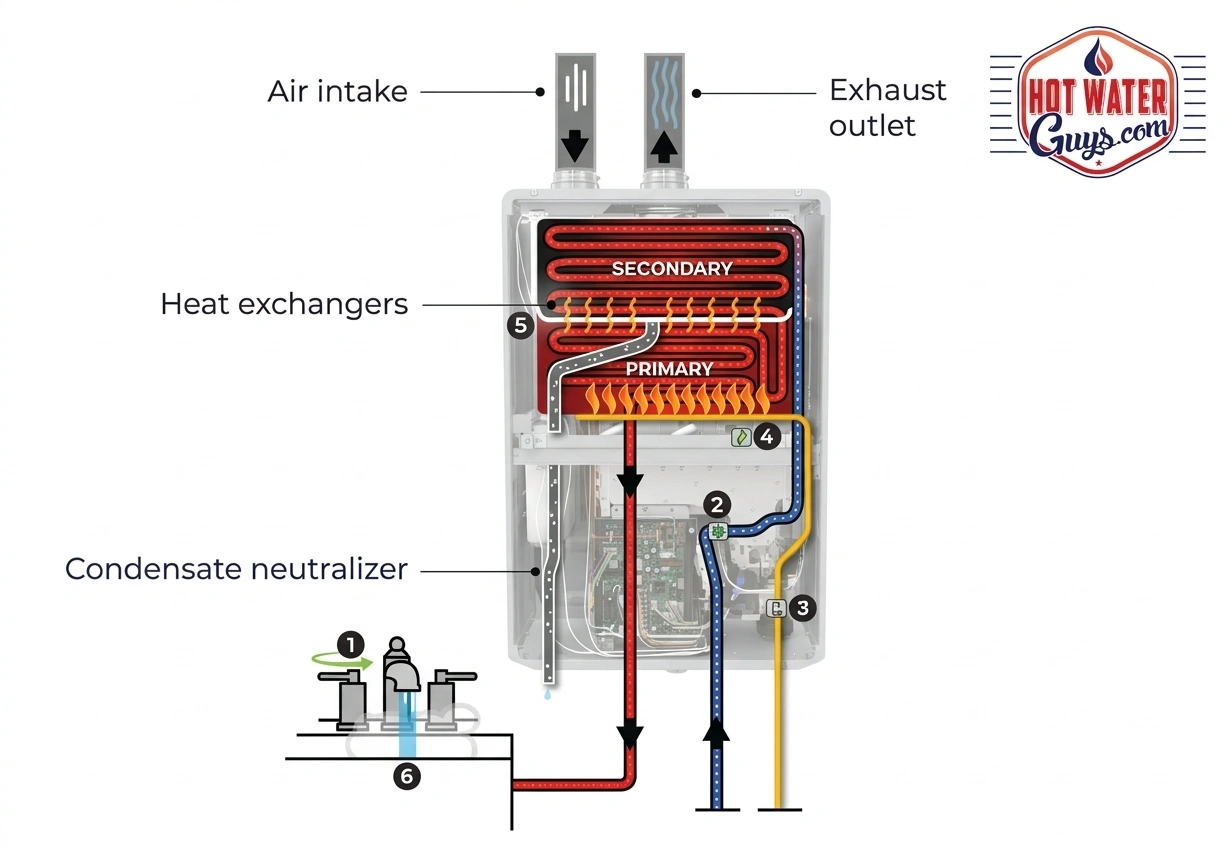
A safe installation comes down to a few non-negotiable rules:
- Choose the right vent type: direct vent, power vent or concentric.
- Match the materials to the heater: PVC or CPVC for condensing units, stainless steel for non-condensing units.
- Calculate the vent length from the manufacturer's specs, counting each 90-degree elbow as five feet of pipe.
- Keep a 1/4-inch upward slope per foot for drainage.
- Meet the termination clearances, like staying 12 inches from windows and doors.
- Install carbon monoxide detectors on every level of your home.
Rule two covers the single most common venting mistake we correct. Here's how the two pipe materials compare:
| Pipe | Installed cost | Where it belongs |
|---|---|---|
| PVC / CPVC | Installed cost $8 to $14 per foot | Where it belongs Condensing tankless units only (95%+ efficiency). Max flue temperature: PVC 140°F, CPVC 194°F. |
| Stainless steel (Category III) | Installed cost $45 to $85 per foot | Where it belongs Non-condensing tankless units (typically 80-84% efficiency). Handles up to 480°F continuous. |
Most venting failures happen because someone used the wrong materials or ignored the manufacturer's specifications. A condensing unit exhausts at around 100°F. A non-condensing unit can hit 400°F. Put standard PVC on a non-condensing heater and you'll melt the pipe.
Which one is right for your install? Read the data plate on your tankless unit. If it's rated condensing, you'll see "ENERGY STAR" and an efficiency rating of 95% or higher, and PVC or CPVC is correct. If the unit is non-condensing, stainless steel is the only safe choice. PVC will melt and release toxic fumes within months. There is no overlap. Don't let any installer talk you into PVC on a non-condensing heater because it's cheaper. We've replaced too many of those vents after the fact.
Why venting is where the danger lives
The stakes are real. Combustion gases contain carbon monoxide, and without proper venting, those gases stay in your home instead of going outside. Every year, hundreds of people die from carbon monoxide exposure, and many of those deaths trace back to improperly vented gas appliances.
Your venting system has two jobs. It expels dangerous exhaust gases safely outside, and in direct vent systems it brings in fresh air for combustion. Both have to work perfectly every time the heater fires.
Houston's building codes are strict about venting for good reason. The city has seen its share of poorly installed systems, and inspectors know what to look for. If your installation doesn't meet code, you'll be tearing it out and starting over.
Every variable adds complexity: indoor or outdoor installation, condensing or non-condensing technology, sidewall or roof termination, natural gas or propane. Each choice cascades into specific requirements for materials, sizing and clearances. Unless you have professional training, this is no DIY project. The margin for error is zero.
I'm Tom Massimin, co-founder of Hot Water Guys. I've been installing tankless water heaters since 1998, long before most plumbers in Houston had even seen one, and over 25 years I've completed thousands of tankless water heater vent installations. I can tell you that venting is where most problems originate. It's where homeowners try to cut corners and general contractors guess at the requirements.
Hot Water Guys has been Houston's tankless water heater specialist since 2003, with 1,400+ five-star reviews across Harris, Galveston, Brazoria, Fort Bend, Montgomery, Liberty, Waller and Chambers Counties.
The three venting systems
The right venting system depends on your home's layout, the heater's location and your budget. Each manages air intake and exhaust in its own way, and we see all three regularly in Houston, Bellaire and Missouri City homes.
Direct vent: the sealed system. A direct vent uses two separate pipes, or a concentric pipe-within-a-pipe design. One pipe draws fresh air from outside for combustion, and the other expels exhaust gases directly outside. Because combustion is sealed, the unit doesn't use indoor air, which makes direct vent systems ideal for smaller spaces like closets or utility rooms where indoor combustion air might be limited. They can save up to 16 square feet of space compared with traditional tank heaters, which is why many homeowners in Cypress and Katy choose them. With combustion isolated from your indoor air, direct vent units are often considered one of the safest options, and we specialize in these tankless installations.
Power vent: the fan-driven system. A power vent has a single exhaust pipe, often flexible, with a fan that pushes combustion gases out of your home. These units typically draw combustion air from the room the water heater sits in, so that space needs to be "unconfined," with adequate air for combustion. Install a power vent unit in a smaller room and you might need additional vents or openings for proper airflow, a common consideration in older homes in areas like Galveston and Sugar Land. The flexibility of a power vent can make installation easier in some scenarios, but it demands careful attention to the indoor air supply.
Concentric vent: the all-in-one. A concentric vent is a pipe-in-a-pipe. The inner pipe carries hot exhaust out while the outer pipe draws in fresh air for combustion. You get a single wall penetration, which looks cleaner and means fewer holes in your home's exterior. The outer pipe also helps insulate the inner exhaust pipe, so the vent stays cooler to the touch, which adds safety by preventing accidental burns. Concentric vents are often easier and faster to install than separate two-pipe systems, a smart choice for minimizing visual impact while maximizing safety. We find them particularly popular in modern builds across Montgomery and Fort Bend counties.
Condensing or non-condensing decides the pipe
The technology inside your heater dictates the vent pipe you must use, and getting this wrong is one of the most common and costly mistakes in any tankless water heater vent installation. A condensing unit is up to 96% efficient because it captures extra heat from the exhaust, which leaves a much cooler flue gas.
Condensing heaters. Condensing tankless water heaters are the champions of efficiency. They extract so much heat from the exhaust that the gases cool down significantly, often below 100°F, and that changes the venting materials. Because the exhaust is cooler, we can use less expensive plastics like PVC, CPVC or polypropylene. They're cheaper and easier to work with, which makes installation smoother and often less expensive. Condensing units are up to 95% more efficient than non-condensing units, which means lower energy use and greenhouse gas emissions, a big win for homeowners in Brookshire and Waller looking to save on utility bills. The cooler exhaust also keeps the vent pipe itself cooler, which adds another layer of safety.
Non-condensing heaters. Non-condensing tankless water heaters have no secondary heat exchanger to capture latent heat, so their exhaust gases are extremely hot, often 300°F to 400°F. Temperatures like that demand Category III stainless steel vent pipe, which is designed to withstand the heat without degrading or posing a fire hazard. The trade-off: stainless steel is significantly more expensive than plastic and needs more specialized tools and techniques to install. Durability is the point, because the vent must withstand constant exposure to high temperatures and corrosive byproducts.
Many homeowners miss this: you can't interchange these materials. Using PVC on a non-condensing unit is a recipe for disaster.
How the two pipes compare in service.
- Lifespan in Houston's climate: PVC/CPVC lasts 25-40 years if installed and sloped correctly. Stainless steel lasts 30-50 years and resists humidity well.
- Condensate handling: PVC/CPVC is designed for it and needs a 1/4" per foot slope back to the unit. Stainless steel isn't designed for sustained condensate and needs a drip leg.
- Installer skill required: PVC/CPVC is lower, with standard solvent-weld joints. Stainless steel is higher, with locking gasketed joints and precise alignment.
- Common failure mode: PVC/CPVC suffers reverse-slope condensate pooling and joints pulling apart at elbows. Stainless steel suffers loose locking-band joints and corrosion at the termination.
- Code acceptance in Houston: PVC/CPVC is accepted for condensing units and must match the manufacturer's spec. Stainless steel is required for non-condensing units and must be UL 1738 listed.
The single most common venting mistake we correct on Houston service calls is the wrong pipe material.
Length, slope, support and termination
A safe, compliant vent installation takes precision. Every detail, from the slope of the pipe to its final termination point, matters, and this is where expertise prevents future problems. We see the consequences of rushed or incorrect work all too often.
Vent length and sizing. When it comes to vent length and sizing, the manufacturer's manual is law. Each tankless model has specific requirements, and ignoring them can lead to inefficient operation, error codes or even dangerous conditions. We calculate the "equivalent vent length," which accounts for every bend and turn in the pipe. A 90° elbow equals 5 feet of straight pipe, and a 45° elbow adds 2.5 feet. Those numbers reflect the added resistance to airflow that each turn creates. The maximum equivalent vent run is typically around 100 feet, though it varies by model and vent diameter. Exceed it and the unit won't vent properly, which leads to safety shutdowns. Proper pipe diameter is also crucial for adequate airflow, and we always double-check these calculations for clients in Spring and Tomball.
Slope. For condensing tankless water heaters, the vent pipe must slope upward at 1/4-inch per foot toward the heater. That lets the acidic condensate, a byproduct of high-efficiency operation, drain back into the unit's condensate trap. Get the slope wrong and condensate can pool, leading to corrosion and system failure.
Condensate. All condensing units need a condensate drain, often connected to a neutralizer, to safely dispose of the acidic liquid. Without it, the condensate can damage your plumbing system.
Support. All vent piping must be adequately supported. We install hangers every 3 feet on horizontal runs and every 5 feet on vertical runs. That prevents sagging, which can create dips where condensate collects or put undue stress on the water heater itself. Connections must be airtight to prevent any leakage of exhaust gases.
Old flues. Never, under any circumstances, use old chimney flues or existing vents from traditional tank water heaters. They aren't designed for the temperatures, materials or airflow requirements of tankless units, and using them is a significant safety hazard.
Maintenance. Even the vent system needs regular care. Our tankless water heater maintenance plans include checking the vent system for blockages and wear.
Termination and clearances. The termination point is where exhaust leaves your home and fresh air enters, so its location is critical for safety and code compliance. You can terminate through a sidewall or the roof, and each has specific requirements.

Minimum clearances are code requirements, designed to keep exhaust from re-entering your home, damaging building materials or bothering neighbors. A sidewall termination must be at least 12 inches from any window, door or other opening, and at least 2 feet from an inside corner and 2 feet from an opposite surface or wall so the exhaust disperses properly. That keeps dangerous gases from being drawn back into the house. A roof termination needs a rain cap or another approved termination method to keep water out, along with specified clearances from rooftop obstructions like other vents or chimneys. We always install screens with a minimum 3/4-inch mesh spacing in each termination, so birds, insects and debris can't enter and block the vent, which can cause system malfunctions. These clearances and protective measures matter in every one of our service areas, from Houston to Splendora.
What Houston code requires in 2026
Houston adopted the 2024 International Residential Code with local amendments, and those amendments matter for tankless venting. The City of Houston Department of Public Works still requires a mechanical permit for any change to a water heater vent system, even a like-for-like replacement. That includes swapping a tank heater for a tankless, switching from a category I to a category IV appliance, and any reroute of an existing vent.
Sealed combustion. The biggest 2026 change: sealed-combustion units are now strongly preferred for any new construction or major remodel where the water heater sits in a conditioned space. Open-combustion units in closets and laundry rooms are still legal in existing homes, but inspectors are flagging makeup-air deficiencies more aggressively. If your unit lives in a closet, expect a closer look at combustion air during the permit inspection.
Sidewall clearances. This is the second pinch point in Houston. The code requires the vent terminal to be at least 12 inches above grade, 4 feet below or 1 foot above any door or window that opens, 4 feet horizontally from any electrical meter or gas regulator, and at least 12 inches from an inside corner. The typical 4-to-6-foot eave overhang on Houston homes complicates this, because the eave forms its own corner relative to the terminal. We've seen permits fail twice on the same install when the original installer ignored the eave geometry.
Roof clearances. Roof terminations need 3 feet vertically from any roof penetration, 8 feet horizontally from any other vent terminal, and a height above the roof that depends on the slope. Most Houston builders default to a sidewall termination for tankless because it's cheaper to permit and easier to inspect.
Humidity. One more local quirk: Houston's high humidity affects condensate handling. Even a non-condensing unit can pull moisture out of the warm intake air on a typical August morning. Code requires a condensate trap on any sealed-combustion vent run longer than 10 feet, and we recommend one on every install regardless of length.
A vent-run check is also part of our annual tankless maintenance service, which is how most venting problems get caught while they're still cheap to fix.
Complex jobs: shared vents, fuel and CO safety
Some tankless water heater vent installations are more complex, particularly commercial applications and large homes in areas like Sugar Land and The Woodlands. Understanding local codes and manufacturer requirements is fundamental to a safe installation. For complex vent work, bring in our licensed water heater installation pros early. A venting plan costs less than a venting fix.
Common venting for multiple heaters. When one tankless water heater isn't enough, you might connect multiple units to a shared vent system. That's common in large residential properties and in commercial settings like restaurants and hotels in Houston. Common venting reduces the number of wall or roof penetrations, which can look better and simplify construction, but it takes specific engineering. Each common-vented heater needs a Non-Return Valve (NRV) in its exhaust to prevent backflow from one unit to another, and the system needs precise sizing for adequate airflow to every connected unit. Our research shows a maximum of 8 heaters may be common vented side by side (horizontally), and a maximum of 3 in a multi-level vertical configuration. The maximum equivalent vent run for a common vent system is typically 100 feet, though it varies by manufacturer and configuration. This is complex work, best left to specialists. See our commercial tankless water heaters guide and commercial tankless service.
Codes come first. Local codes supersede everything else. In Houston, Bellaire and all of our service areas, we follow the specific building codes and ordinances, which often build on national standards like the National Fuel Gas Code (ANSI Z223.1/NFPA 54) and can add their own unique requirements. Always verify with local authorities before starting any installation.
Fuel type. Natural gas or propane can also change the venting requirements. Both produce similar combustion byproducts, but propane has a higher heat output. Using propane tankless water heaters reduces energy consumption and greenhouse gas emissions by about 50%, a significant benefit, though some non-condensing propane units may need special stainless-steel venting. Always consult the manufacturer's specifications for your fuel type. Our team is well-versed in both natural gas and propane installations across our service area. For general propane safety information, see the Propane Education and Research Council.
Carbon monoxide detectors. We recommend a detector on every level of your home and in every bedroom. They're your last line of defense against improper venting or other gas appliance malfunctions. If you smell gas, leave the building immediately and call your gas provider or 911 from a safe distance. Don't operate any electrical switches or use phones inside. Treat it as a life-saving protocol, every time.
Proper tankless water heater vent installation is a matter of safety, efficiency and longevity. Understanding the principles helps, but the execution has to be flawless, and the variables run from local Houston codes to the specific requirements of your unit. For a job this critical, professional installation is the only way to guarantee peace of mind. Hot Water Guys specializes in this precision work and has served Houston, Bellaire, Missouri City and the surrounding areas for over two decades. We know the nuances of condensing and non-condensing units, the intricacies of common venting and the imperative of safety, and from initial sizing to final termination, we make sure your tankless water heater is installed correctly and safely, every time. Learn more about our tankless water heater services or get a free quote.
Common questions
Can I use my old water heater's vent for a new tankless unit?
No. The materials and sizing of an old tank water heater vent are almost always incompatible with a tankless unit. Old tank heaters often used galvanized B-vents, which aren't designed for the temperatures or exhaust characteristics of tankless units. Non-condensing tankless heaters need Category III stainless steel, and condensing units use plastics like PVC or CPVC because their exhaust is much cooler. Using the wrong vent is a fire and carbon monoxide hazard, and it will void your warranty.
What is the most common tankless venting mistake?
The most common mistake we encounter is using the wrong venting material, such as standard PVC pipe on a non-condensing unit, which will quickly melt and release toxic fumes. Another frequent error is improper slope. Condensing units need a slight upward slope (1/4-inch per foot) toward the heater so corrosive condensate can drain. Get it wrong and condensate can pool in the vent, leading to corrosion, blockages and premature system failure. Both errors are serious safety risks.
Do outdoor tankless water heaters need to be vented?
No. Outdoor tankless water heaters are designed to be self-venting. They draw combustion air directly from outside and release exhaust gases directly back into the outside air, so no vent pipes run through your walls or roof. That makes them a popular choice in warmer climates like Houston, freeing up indoor space. Outdoor units still need proper clearances and protection from the elements, as the manufacturer specifies.
Can you vent a tankless water heater through the roof?
Yes. Roof termination is allowed for both condensing and non-condensing tankless units, and it's often the cleanest-looking choice. The vent must extend at least 3 feet above the highest point where it passes through the roof, sit 2 feet higher than any structure within 10 feet, and stay 8 feet horizontally from any other vent terminal. With Houston's mild winters, ice damming isn't a real concern. What does matter is UV exposure on PVC over decades, so we use UV-resistant PVC or paint the exposed run.
What size vent pipe does a 199,000 BTU tankless need?
Most 199K BTU tankless units use either 3-inch or 4-inch vent pipe, depending on the equivalent vent length. Under about 35 equivalent feet, 3-inch is acceptable for most condensing models. Over that, you step up to 4-inch to avoid back-pressure. Each 90-degree elbow counts as five feet and each 45 as 2.5 feet, and the manufacturer's installation manual is the final authority. Rinnai, Navien and Rheem each publish slightly different tables.
How far can you run vent pipe on a tankless water heater?
Maximum equivalent vent length varies by manufacturer and unit size, but the typical range is 35 to 65 equivalent feet, and some units allow up to 100 feet with the right pipe diameter. Equivalent length counts more than the straight pipe: each elbow adds five feet (90°) or 2.5 feet (45°), and the termination cap usually counts as five feet. Always check the unit's installation manual. We see installers blow the limit by not counting elbows correctly.
Can PVC be used for a non-condensing tankless?
No. Non-condensing tankless units exhaust at temperatures up to 400°F, while PVC softens above 140°F and CPVC above 194°F. PVC on a non-condensing unit is a fire hazard and a code violation. Non-condensing units need UL 1738 listed Category III stainless steel vent pipe. If you have a non-condensing tankless heater vented with PVC, shut it off and call a licensed installer immediately.
Does each tankless unit need its own vent?
For most installs, yes. Each tankless heater gets its own dedicated vent run. Common-venting two or more units is only allowed when the manufacturer publishes a tested manifold kit, and even then the rules on pipe sizing, total length and unit pairing are strict. Rinnai's Multi-System and Navien's NaviLink common-vent kits are the most widely used in Houston, but they need careful sizing. If your installer suggests tying two units into one vent without a tested manifold, find another installer.