01
Free assessment and sizing.
We ask about your family size, bathrooms, daily routine and busiest hour, then work out the first-hour rating you need.

Gas and electric tanks installed from $2,500.
Tankless gets the attention, but for many Houston homes a tank still makes more financial sense: lower upfront cost, simpler installation and proven reliability. We install both every day, so we have no horse in the race. We’ll tell you which one fits your house.

A tank keeps 40 to 80 gallons hot, and a properly sized one fills a 60-gallon soaking tub faster than most tankless units can heat it on the fly.
A quality 50-gallon gas tank installed runs $2,500 to $3,500 in Houston. A comparable tankless installation runs $4,200 to $5,500 with the gas line upgrade most homes need.
Fewer components mean fewer things to break, cheaper repairs and more technicians who can service it. Foam insulation cuts standby loss 40 percent versus 10-year-old models.
A tank’s first-hour rating (FHR) is how many gallons of hot water it can deliver in its first hour of use, and it matters more than the size on the label. A 50-gallon tank with a high FHR can outperform a 65-gallon tank with a low one.

Our sizing rule after 20 years of Houston installations: 40 gallons for 1 to 2 people, 50 gallons for 3 to 4, and 80 gallons for 5 or more or a home with a large soaking tub. A couple with one bathroom needs 30 to 40 gallons.
How many showers run back to back? Is the dishwasher running at the same time, or the washing machine on hot? Those overlapping demands decide whether 50 gallons is enough, so we calculate the FHR for every installation.
Oversizing wastes energy heating water you don’t use. Undersizing means cold showers. We get it right by asking the questions that matter, instead of defaulting to the biggest tank in the catalog.
We tell homeowners at least twice a week that for a lot of Houston homes, a tank is still the smarter choice. Walk into any Houston plumbing forum and you’ll see the opposite advice: “Go tankless, it’s 2026.” For some homes, that’s solid counsel. For a three-bedroom house in Alief with two bathrooms and a family of three, a $2,500 tank installation often makes more financial sense than a $4,200 tankless system.
A quality 50-gallon gas tank installed runs $2,500 to $3,500 in Houston, and a comparable tankless installation runs $4,200 to $5,500, including the gas line upgrade most homes need. On energy savings alone, that difference typically takes 12 to 20+ years to pay back, and ENERGY STAR puts the savings at about $95 a year for a family of four. If you plan to sell your home within 3 years, tankless doesn’t pencil out. If your gas line can’t support a 199,000 BTU unit without a $600 upgrade, the math gets worse.
We install both systems every day and have no incentive to push one over the other. When a tank makes more sense, we say so.
Standby heat loss is the heat that escapes through the tank walls while the water sits idle. It’s real, but on a modern, well-insulated tank it comes to roughly $4 to $7 a month in Houston, or $50 to $84 a year. Modern tanks from Rheem, A.O. Smith and Bradford White use foam insulation that cuts standby loss by 40 percent compared with models from 10 years ago. Some higher-end models add powered anode rods that actively prevent corrosion instead of relying on a sacrificial rod that wears away.
Compared with the price of going tankless, where installs run $4,200 to $8,000, the standby argument weakens significantly for smaller households. If your tank fails and you need hot water today, paying significantly more to save about $6 a month doesn’t always make sense. Most months we install more tankless units than tanks, and we still think you deserve the real numbers before you decide.
About 75 percent of the tanks we install in Houston are gas. Gas heats water roughly twice as fast as electric, so it recovers faster between heavy use: a 50-gallon gas tank recovers in about 30 to 40 minutes, while the same size electric tank takes 60 to 80.
Electric still has its place. If your home has no gas line to the water heater location, adding one costs $400 to $800 depending on the distance, and a high-efficiency electric tank may be the better value. Electric tanks also need no combustion venting, which makes them easier to fit in tight spaces like interior closets, where running a flue pipe isn’t practical.
Heat pump (hybrid) water heaters are gaining traction in Houston because they use roughly 60 percent less electricity than standard electric tanks. They pull heat from the surrounding air and move it into the water, like an air conditioner running in reverse. The trade-offs: they need about 7 feet of ceiling height and 750 cubic feet of air space, they make about as much noise as a window AC unit, and they cool the air around them. In a Houston garage in summer, that cooling is a bonus. In a utility closet, it’s a problem. We’ll look at your space and tell you whether a heat pump model makes sense.
A gas tank has a burner at the bottom that heats the tank floor. Hot water rises naturally (thermosiphoning), so the hot outlet sits at the top and a dip tube feeds cold water to the bottom. The thermostat fires the burner when the water drops below the set point, typically 120°F.
An electric tank uses one or two heating elements, one near the top and one near the bottom. The upper element heats first for a quick supply, then the lower element heats the rest of the tank. If the upper element fails, you get no hot water at all. If the lower one fails, you get hot water at first, but it runs out faster because only the top of the tank is heating. That’s why we test both elements on every service call.
We drain the old tank, disconnect the gas and water lines and haul the unit away. If it has been leaking, we check the area for water damage and tell you if anything needs attention before the new unit goes in. We don’t install on top of existing water damage.
Every tank installation in Houston needs a temperature and pressure (T&P) relief valve with a discharge pipe routed to within 6 inches of the floor, an expansion tank if the home has a pressure reducing valve or backflow preventer on the main line, a drip pan if the unit sits above living space, and gas and water connections in approved materials.
The expansion tank matters because water expands as it heats. In an open system, that expansion pushes back into the city main. In a closed system, with a PRV or backflow device, the pressure has nowhere to go except your fixtures, your T&P valve or, at worst, the tank itself. Houston code requires an expansion tank in that case: a small pressurized vessel, usually 2 to 5 gallons, mounted on the cold inlet above the heater. We include it in the quote whenever your system needs one.
We also check the venting. Older Houston homes sometimes have single-wall vent pipe that must be upgraded to double-wall B-vent. It’s a safety upgrade: single-wall pipe can overheat surrounding materials in enclosed spaces.
We fill the tank, check every connection for leaks, verify the T&P valve works, light the pilot on gas models and test the temperature at the nearest fixture. We set the thermostat to 120°F, the recommended setting for safety and efficiency, and show you how to adjust it. Then we cover the maintenance basics: flush the tank every year, check the anode rod every 3 years and keep the area around the unit clear of flammable materials.
A standard tank lasts about 6 to 8 years in Houston’s water, compared with the 8 to 12 years A.O. Smith gives as the national range. Some last longer with diligent maintenance, and some fail sooner if the anode rod is never replaced. Houston’s water is hard enough to speed up sediment buildup inside the tank, which cuts heating efficiency and contributes to corrosion at the bottom. An annual drain-and-flush extends tank life by keeping that sediment layer from baking onto the bottom. It’s a 20-minute job most homeowners can do with a garden hose, or we’ll do it for $150 during a service call.
The anode rod is the unsung hero. This sacrificial metal rod corrodes so the tank walls don’t. In Houston’s mineral-rich water, anode rods wear out faster than the national average, sometimes in 3 to 4 years instead of 5. Once the rod is gone, the tank starts corroding from the inside, and by the time you see rust-colored hot water, the damage is well underway. Replacing an anode rod costs $130 to $175 and can add 3 to 5 years to a tank’s life. Our tank maintenance service covers the flush and an anode rod inspection. If the rod needs replacing, typically every 3 to 4 years in Houston, we quote it separately so there are no surprises.
Most of our tank installations are replacements: a 9-year-old unit that started leaking, rust-colored hot water that won’t clear, or a tank limping through repair after repair. Replace rather than repair when the tank itself is leaking (not a fitting or valve), the unit is past 10 years old with repeated failures, recovery keeps getting slower or you see rust in the hot water. Not sure which side of that line you’re on? Our water heater repair team will give you honest repair-versus-replace math with real numbers for both.
We replace water heaters across Greater Houston every day, in Houston, Katy, Sugar Land, Cypress, Spring, Tomball, Conroe and the surrounding counties, from Katy to Baytown and The Woodlands to Pearland. Call 832-673-0909 with your tank’s age and what it’s doing, and we’ll tell you over the phone whether replacement makes sense and what it will cost. You can also book online.
Installed, permit included
Like-for-like replacement: the unit, removal and haul-away, the City of Houston permit and required code parts.
A like-for-like tank replacement in Houston runs $2,500 to $4,500 installed. That covers the unit, removal and haul-away of the old tank, the City of Houston permit and code-required parts like the T&P discharge line, the drip pan and an expansion tank where your system needs one. Tank size, fuel type and any code upgrades decide where you land.
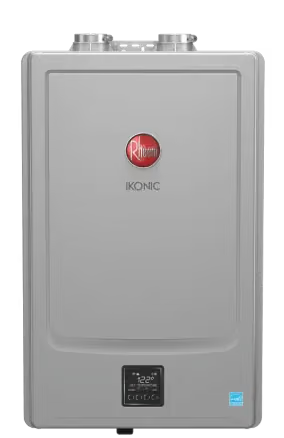
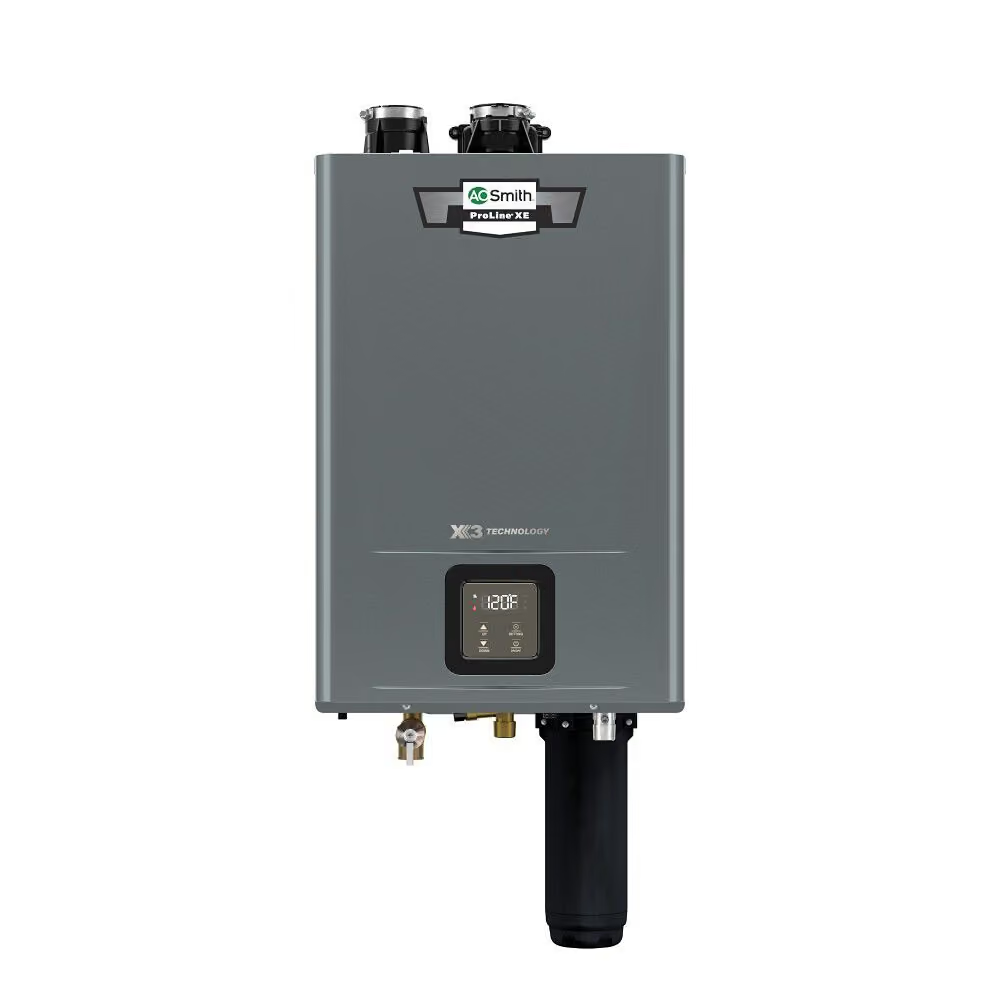
Want to use the replacement as a chance to upgrade? A tank-to-tankless conversion runs $4,200 to $8,000, depending on the venting and gas line work. Our guide to the cost of replacing a gas water heater with tankless breaks down every line item.
Four steps, from a free assessment to a tested tank set at 120°F, and in most cases a single visit.
We ask about your family size, bathrooms, daily routine and busiest hour, then work out the first-hour rating you need.
Call 832-673-0909 for a ballpark range over the phone. If you go ahead, a visit gets you a firm written quote.
We remove the old tank, check for water damage if it was leaking, and install the code-required safety parts your system needs.
We check every connection, test the T&P valve and the output, set the thermostat to 120°F and walk you through the maintenance basics.
We install Rheem, A.O. Smith and Bradford White tanks, among others. All three are manufactured in the US, have responsive warranty support and make units rated for Houston’s hard water.
Rheem’s Professional Series is our most-installed tank line because of its 12-year warranty, push-button ignition (no standing pilot light) and solid build quality at a mid-range price. A.O. Smith’s ProLine performs comparably and is our go-to for builder-grade replacements on a budget. Bradford White’s Defender Safety System tanks are the most robust option we carry, with a built-in flame arrestor and a screenless design that resists lint and dust, which makes them ideal for garage installations in Houston homes with pets.
Every tank we install is insulated steel with adjustable temperature controls, a pressure relief valve and standard residential connections, in gas or electric, with Energy Star rated options.
We’ll tell you when tankless makes more sense: when your household routinely runs out of hot water even with a properly sized tank, when you’ll stay in the home long enough to recoup the price difference, or when you want back the floor space a tank takes up.
The worst outcome is buying the wrong system because someone only sells one type. We sell both and install both, and we’ll give you the numbers for each so you can compare like for like.
Confirm the service address and project with the team. Some areas are subject to an additional travel fee.
For most Houston households, a 40-gallon tank suits 1 to 2 people, a 50-gallon tank works for 3 to 4, and a 75-gallon or larger tank is recommended for 5 or more. Your real need depends on peak-hour demand: how many showers, appliances and faucets run at the same time during your busiest hour. We calculate your first-hour rating (FHR) on the site visit and recommend the right size.
A standard tank-to-tank replacement typically takes 2 to 4 hours. That covers draining and removing the old unit, setting the new tank, connecting the water and the gas or electric lines, and a full safety inspection. If code upgrades are needed, such as adding a drip pan or an expansion tank or updating the venting, the job may take another 1 to 2 hours.
Natural gas is more popular in Houston because gas is relatively inexpensive and heats water faster than electric. Electric tanks are a great option if your home has no gas line or you want a lower upfront installation cost. Gas tanks usually cost slightly more to install because of the venting, but they cost less to run each month. We’ll look at your home’s existing setup and help you choose the most cost-effective option.
A full tank replacement in Houston typically runs $2,500 to $4,500, depending on the tank size, the fuel type and any code-required upgrades, such as an expansion tank, new venting or a drip pan. We give transparent estimates over the phone, so you know what to expect before we arrive.
Tell us its size and whether it runs on gas or electric. We’ll quote the new tank, the haul-away and the City of Houston permit as one installed price.