
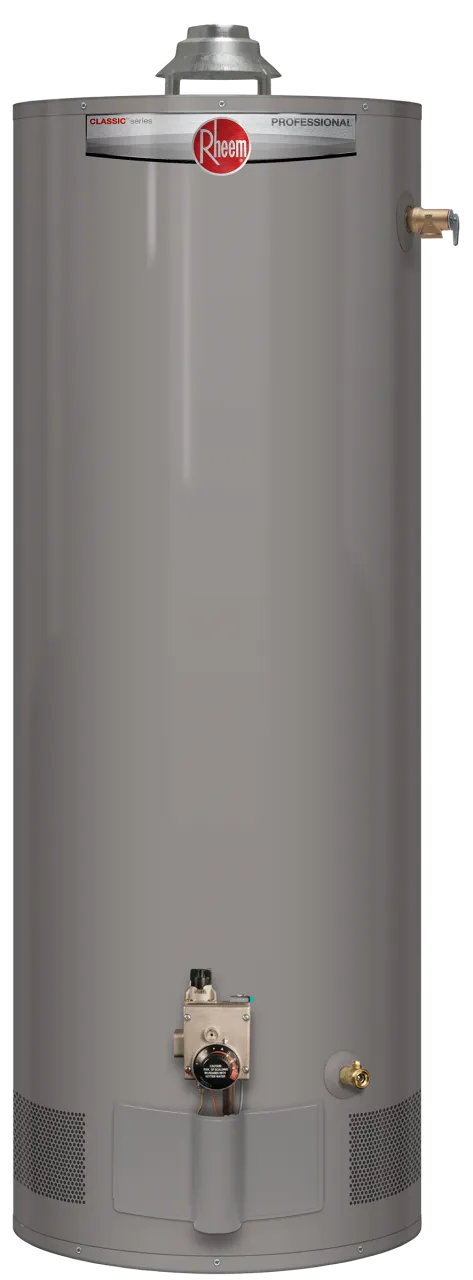
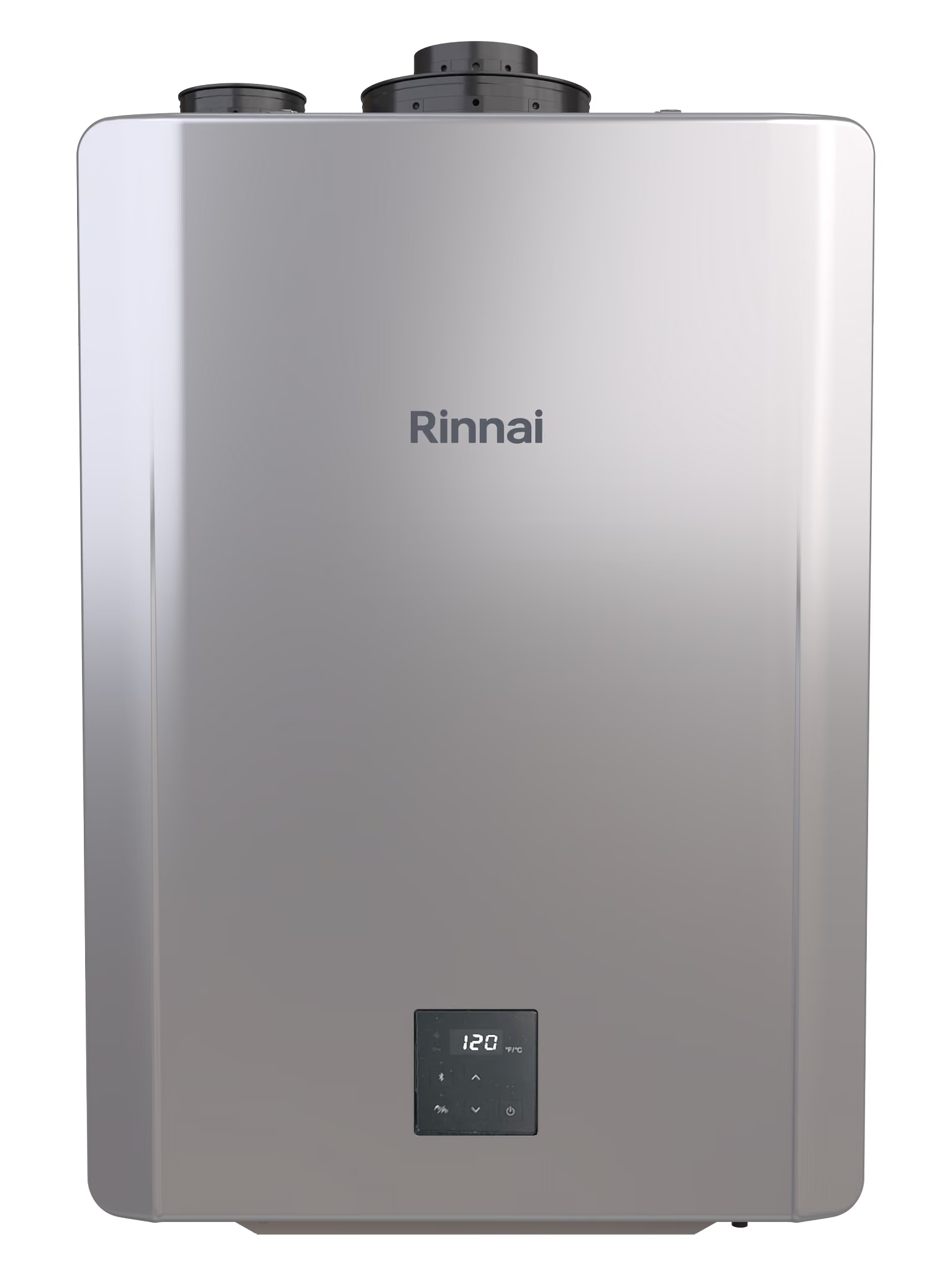
Representative manufacturer equipment: Rheem Professional Classic Atmospheric gas storage family and Rinnai SENSEI RX family. Images are not to scale; they do not confirm a model recommendation or availability.
The differences
that matter.
This comparison covers conventional gas or electric-resistance storage and gas tankless. Heat-pump storage is a separate option, explained below.
What to compare | Conventional tank | Gas tankless |
|---|---|---|
How it heats | Conventional tank A gas burner or electric resistance elements heat a stored supply. | Gas tankless A burner heats water as it passes through the unit. |
Published installed cost | Conventional tank $2,500–$4,500 for like-for-like tank replacement. | Gas tankless $4,200–$8,000 for tankless installation/conversion. |
How to size it | Conventional tank Match first-hour rating to peak-hour hot-water demand; tank gallons alone are insufficient. | Gas tankless Match simultaneous hot-water flow to the model output at the required temperature rise. |
Busy periods | Conventional tank Stored water can meet short peaks; delivery then depends on remaining storage and recovery. | Gas tankless Can keep heating during extended use, within the system’s flow and heating capacity. |
Energy and running cost | Conventional tank Stored water loses some heat while idle. Fuel and model efficiency affect running cost. | Gas tankless Avoids keeping a large tank hot, but savings depend on the comparison system and household use. |
Installation planning | Conventional tank Check fuel/electrical connections, location, access and required plumbing or venting work. | Gas tankless Assess gas supply, power, venting, clearances and condensate drainage when applicable. |
Space | Conventional tank Needs space for the cylinder plus required installation and service clearances. | Gas tankless A wall-mounted unit can release floor space, with clearances and service access still required. |
Care and water quality | Conventional tank Follow the manufacturer’s maintenance schedule; sediment and corrosion protection need attention. | Gas tankless Follow the manufacturer’s schedule for scale control, filters and system inspection. |
Service life and warranty | Conventional tank Actual service life varies with the equipment, installation, water conditions and care. | Gas tankless Actual service life varies with the equipment, installation, water conditions and care. |
Compare the scope, too.
The published Hot Water Guys ranges compare like-for-like tank replacement with tankless installation or conversion. They are planning estimates for different projects. Ask a written quote to identify equipment, removal, required upgrades, permit requirements, and included work. Heat-pump storage is not priced by either range.
Size for the busy part
of your day.
For storage:
the busiest hour.
A tank’s first-hour rating accounts for its stored water and recovery during an hour. Match that rating to your peak-hour hot water demand. Tank volume or household size alone cannot settle the choice.
For tankless:
what runs together.
Add the hot-water flow needed by fixtures you may use at once. Then check the model’s output at the temperature rise required, including colder incoming water. A headline maximum GPM is only part of the picture.
Hot water still needs to travel through the pipes. Recirculation can reduce the wait in a suitable system; tankless alone does not promise instant water at a distant tap.
There’s another
kind of tank.
Heat-pump water heaters deserve their own comparison.
A heat-pump water heater stores hot water, but uses electricity to move heat from the surrounding air. Many models also have resistance elements for backup.
It can use less electricity than conventional resistance storage. Space, airflow, ambient temperature, drainage, electrical provision, and peak demand all need assessment. Ask about current service availability and a separate quote for this option.
Start with
your priorities.
These are useful starting points for a conversation, with the final recommendation based on your home.
A straightforward replacement is the priority.
Compare a properly sized conventional tank when minimizing initial project cost and reusing a suitable existing installation matter. Verify that its first-hour delivery meets the busiest part of the day.
Longer hot-water use or floor space matters.
Explore tankless when extended draws or reclaiming floor space are priorities and the home can support the required capacity and installation. Size simultaneous use before choosing a model.
An electric home is being upgraded.
Include heat-pump storage in the assessment rather than limiting the choice to resistance storage or electric tankless. Compare household demand, location and available electrical capacity.
Good questions.
Useful answers.
Budget, capacity, and the practicalities of changing systems.
Which option is cheaper?
A like-for-like conventional tank replacement generally starts lower in HWG’s published ranges: $2,500–$4,500, compared with $4,200–$8,000 for tankless installation or conversion. These are different project scopes. Compare written quotes and expected energy and maintenance costs; neither range establishes a universal payback.
Will tankless give every shower unlimited, instant hot water?
Tankless can heat during extended use, but output is limited by simultaneous flow and the temperature rise needed. Water also has to travel through the pipes to the tap. Correct sizing and, where suitable, a designed recirculation system address different parts of the problem.
How do you choose the right size?
For storage, compare the first-hour rating with the household’s busiest hour. For tankless, add the hot-water demands that may overlap and check the manufacturer’s output at the required temperature rise. Existing tank volume, number of people and headline maximum GPM do not settle the choice by themselves.
Can I replace my tank with tankless using the same connections?
That depends on the home and selected model. A conversion assessment checks gas or electrical capacity, venting, placement, access, water connections and drainage where needed. Ask the quote to identify retained connections and required upgrades instead of assuming every existing connection can be reused.
Is a heat-pump water heater the same as an electric tank?
It stores hot water, but uses electricity to move heat from surrounding air rather than relying only on resistance elements. Many models have resistance backup. It can use less electricity than conventional resistance storage, but needs suitable space, airflow, temperature, drainage and electrical provision. Assess it as a separate option.
Let’s look at
your home.
Tell us what you have, what’s changed, and what you want from the next system. We’ll help you compare a suitable tank with a suitable tankless installation.