Tankless vs Tank Water Heater: Which Is Right for Your Houston Home?
A head-to-head comparison of tankless and tank water heaters for Houston homes, covering cost, lifespan, flow rate, hard water impact, and a decision framework.


A tankless vs tank water heater decision comes down to five factors: upfront cost, monthly operating cost, lifespan, hot water capacity, and how Houston's hard water affects each one. This guide covers all five with real numbers.
Most comparison guides recycle the same national averages. This one is built around Houston. Your groundwater temperature, your mineral hardness levels, your permit requirements, and your natural gas pricing all shift the math in ways that generic guides miss.
By the end, you will know which type fits your household, your budget, and your timeline.
What Is the Core Difference Between Tankless and Tank Water Heaters?
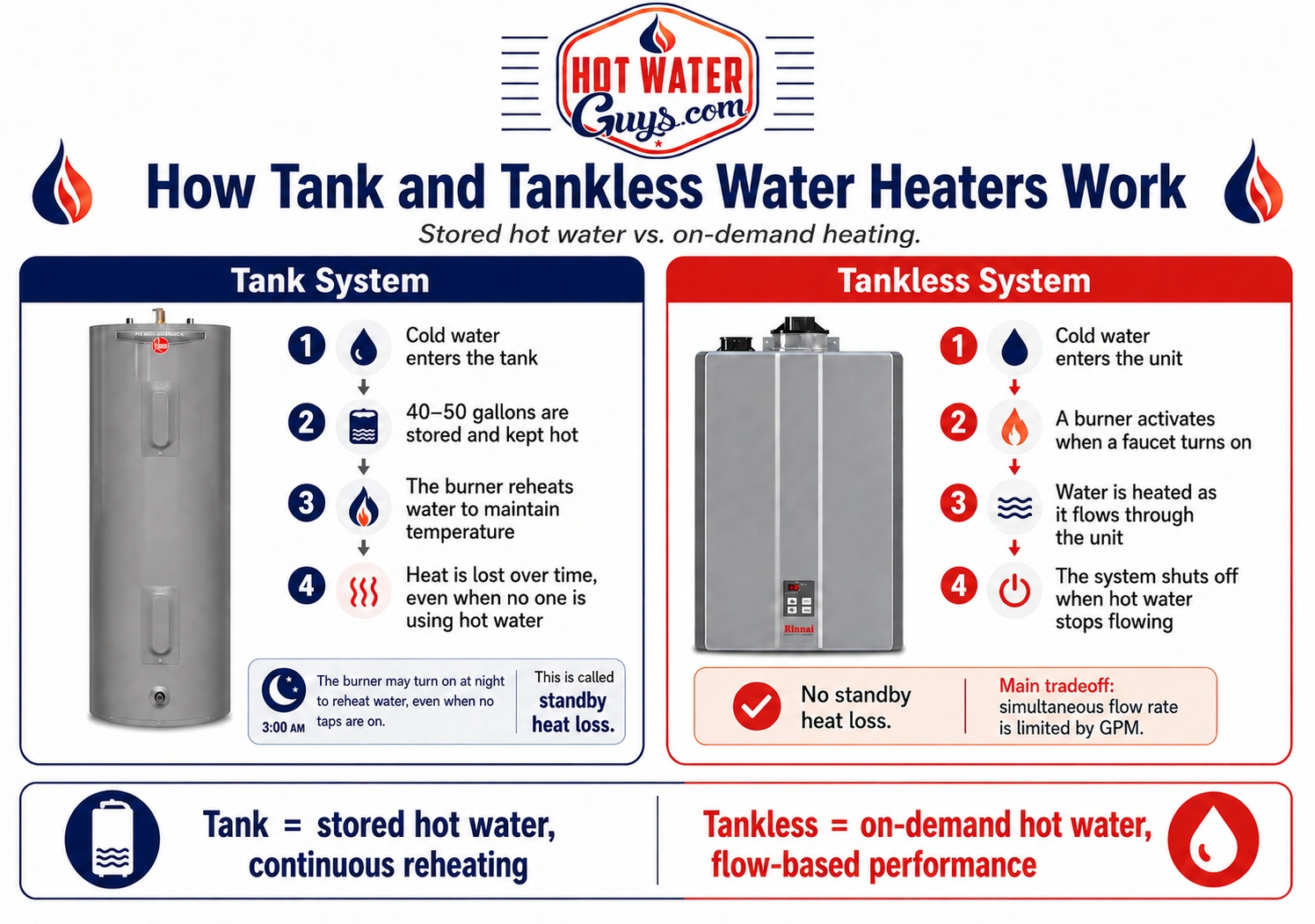
A tank water heater stores 40–50 gallons of hot water and keeps it heated around the clock. A tankless water heater heats water on demand the moment you turn on a faucet. That single difference drives every other comparison point.
Tank units reheat water continuously, even at 3 a.m. when nobody is using it. That cycle is called standby heat loss. It accounts for a meaningful share of your monthly energy bill.
According to the U.S. Department of Energy, water heating represents 18–20% of a typical home's total energy use. Standby loss is the largest controllable piece of that cost.
Tankless units eliminate standby loss entirely. They fire only when hot water flows through the unit. The tradeoff is a limit on simultaneous flow rate, measured in gallons per minute (GPM).
How Do Upfront Costs Compare: Tankless vs Tank?
A tank water heater starts at $2,500 installed at Hot Water Guys. A gas tankless system starts at $4,200 installed. Most other Houston plumbers charge $3,000+ for tank and Up to $10,000. for tankless. The gap is real, and pretending otherwise does not help you plan.

Tank installations run 2–4 hours. Most Houston homes already have the connections in place for a direct swap.
Tankless jobs run 6–10 hours and often require new venting, gas line upgrades, or electrical work. That labor difference is the main reason tankless costs more upfront.
For a full breakdown of every cost layer, see our water heater cost guide for Houston.
Which One Costs Less to Operate Each Month?
Tankless water heaters cost 20–34% less to operate than tank units for the average Houston household. The savings come from eliminating standby heat loss.
The U.S. Department of Energy reports that tankless units are 24–34% more efficient for homes using 41 gallons or less per day. For high-usage homes consuming around 86 gallons daily, the efficiency gain drops to 8–14%.
According to Repipe Solutions' Houston-specific analysis, local homeowners save 20–40% on water heating costs after switching to tankless.
Houston's warm groundwater gives tankless units a natural advantage. Incoming water arrives at roughly 67–77°F depending on season, meaning the unit has less temperature rise to produce.
Here is what the 20-year math looks like for a typical Houston home with a gas connection:

Tank owners pay twice for installation and more each month on energy. Tankless owners pay more upfront and invest in annual maintenance ($195 per year at Hot Water Guys) but avoid the second replacement entirely.
If your tank lasts only 7 years in Houston's hard water, add a third replacement to the tank column. That pushes the tank's 20-year total above $15,000, and the tankless option becomes the clear winner on cost alone.
How Long Does Each Type Last in Houston?
Tank water heaters typically last 6–8 years, regardless of whether you have hard water or not. In contrast, tankless units last 15–20+ years with proper maintenance.
A.O. Smith's comparison data confirms that gas tank water heaters can begin to fail as early as 6 years after installation. Sediment buildup, corrosion, and anode rod depletion are the primary causes.
In Houston, Harris County water at 12–17 grains of hardness accelerates all three.
Tankless units avoid the most common failure points. There is no tank to corrode and no standing water to accumulate sediment. The heat exchanger is the primary wear component, and annual descaling keeps it functioning at full efficiency.
Over a 20-year window, most Houston homeowners replace a tank heater at least twice. A properly maintained tankless unit lasts the full span. That replacement math is the single biggest factor in the long-term cost comparison.
How Does Houston's Hard Water Affect Each Type?
Houston's hard water damages both types, but it destroys tanks faster. Harris County water runs 12–17 grains of hardness. The U.S. Geological Survey classifies this level as "very hard."
In a tank unit, minerals settle to the bottom and form a layer of calcified sediment. That layer insulates the water from the burner, forcing the unit to run longer and hotter. You hear it as popping or rumbling sounds.
Over time, the sediment accelerates corrosion of the tank lining. Once the tank wall fails, the unit is done.
In a tankless unit, hard water deposits form inside the heat exchanger. Left unchecked, scale restricts water flow and reduces efficiency.
The difference is that descaling reverses the damage. Annual flushing with a dedicated descaling solution removes the buildup and restores the unit to full performance.
Tank sediment, by contrast, is not fully reversible. You can flush a tank annually to slow the buildup, but the corrosion it causes is permanent.
In Houston, that difference makes regular tankless maintenance a much better long-term investment than repeated tank flushes that only delay the inevitable.
What About Hot Water Capacity and Flow Rate?

A 50-gallon tank gives you 50 gallons of hot water, then you wait 30–45 minutes for recovery. A tankless unit gives you unlimited hot water, but only up to its GPM rating.
Flow rate is the limiting factor for tankless units. Each fixture in your home draws a specific amount:
- Shower: 2.0–2.5 GPM
- Kitchen faucet: 1.0–2.0 GPM
- Dishwasher: 1.0–1.5 GPM
- Washing machine: 1.5–2.0 GPM
If two showers and a dishwasher run simultaneously, you need roughly 6–7 GPM. Most whole-house gas tankless units deliver 7–9 GPM, which handles that load comfortably. Larger homes with four or more bathrooms may need a higher-capacity unit or two units in parallel, a common scenario for tankless installation in Katy, where multi-bathroom family homes are the norm.
Houston's warm groundwater gives tankless units an advantage here. Incoming water at 67–77°F requires less temperature rise to reach 120°F. Your unit delivers a higher effective flow rate than the same unit in a northern climate.
A Rinnai CX199 that produces 7.3 GPM at 67°F groundwater delivers over 9 GPM when incoming water is 77°F, according to Rinnai's ground water performance data. The RX199, which is a residential unit, likely offers the exact same performance.
Tank units do not have a flow rate limit, but they have a capacity limit. Once the stored water is depleted, the recovery time leaves you waiting.
For households that stagger their hot water usage, a tank works fine. For households with simultaneous demand, tankless water heater installation solves the problem permanently.
How Does Installation Complexity Compare?
Tank swaps are simpler and faster. Tankless installations require more labor and may need gas line, venting, or electrical upgrades.
A standard tank-to-tank replacement takes 2–4 hours. The plumber disconnects the old unit, positions the new one on the same connections, and tests for leaks and proper operation. Most Houston homes are already configured for this swap.
A tank-to-tankless conversion is a different project. The plumber must mount the unit on a wall, run new venting to the outside, and verify the gas line diameter. Typical timeline: 6–10 hours.
At Hot Water Guys, the difference between a tank installation (from $2,500) and a tankless installation (from $4,200) reflects that additional scope. Most other Houston plumbers charge $6,000+ for the tankless job.
If your home already has a tankless unit, the replacement is significantly easier. The connections, venting, and gas line are already in place. A tankless-to-tankless swap takes 3–5 hours and costs roughly the same as a tank replacement in labor.
Which Type Should You Choose? A Houston Decision Framework
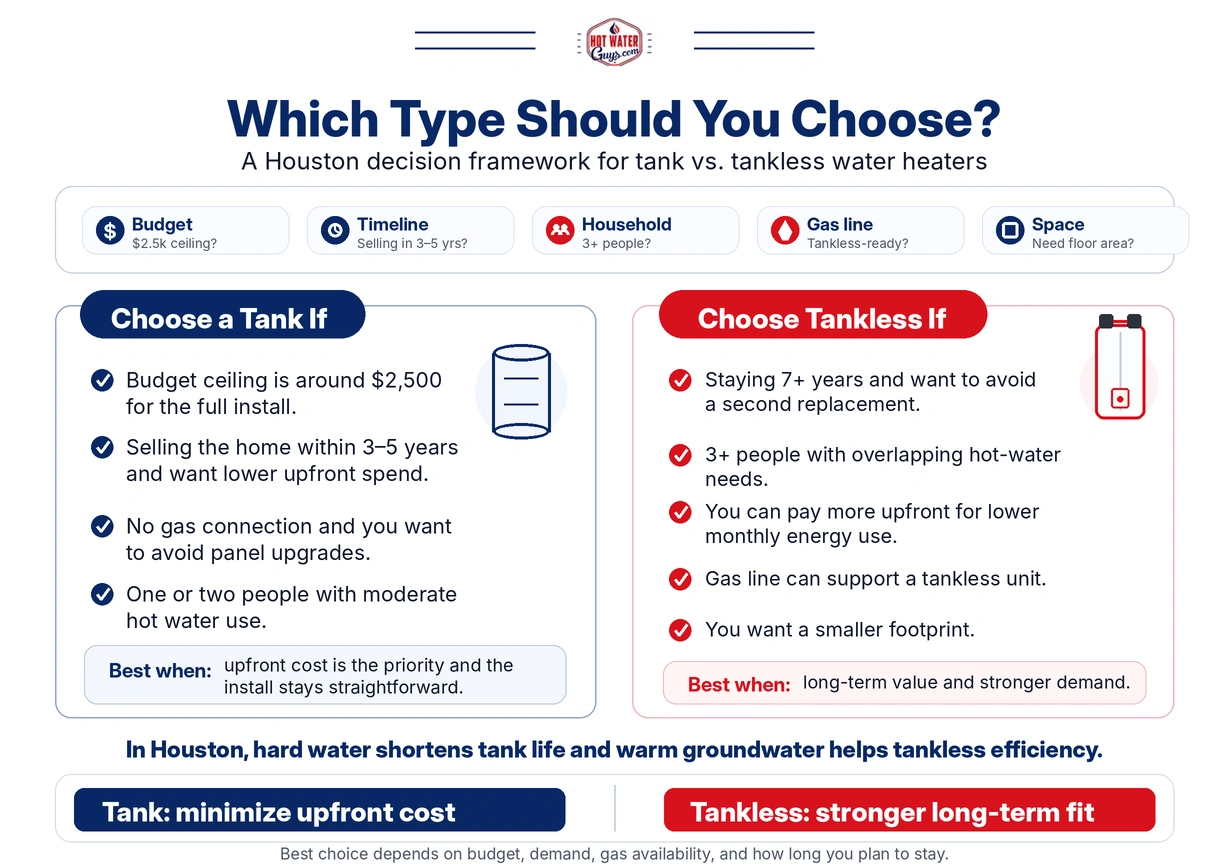
The right answer depends on your budget, household size, gas availability, and how long you plan to stay in your home. Here is the framework:
Choose a Tank Water Heater If:
- Your budget ceiling is around $2,500 for the full installation.
- You are selling the home within 3–5 years and want to minimize upfront spending.
- Your home has no gas connection and you want to avoid electrical panel upgrades.
- You live alone or with one other person and use moderate amounts of hot water.
A tank water heater is the right call when upfront cost is the primary constraint. The unit works well, heats water reliably, and the installation is straightforward.
Choose a Tankless Water Heater If:
- You plan to stay in your home for 7+ years and want to avoid a second replacement.
- You have a household of 3+ people with overlapping hot water needs.
- You want lower monthly energy bills and are willing to pay more upfront.
- Your home has a gas line that can support a tankless unit.
- Space matters and you want to free up the floor area a tank occupies.
A tankless water heater pays for itself over time, especially in Houston where hard water shortens tank life and warm groundwater boosts tankless efficiency.
The Houston Factor
Houston tilts the comparison in favor of tankless more than most cities. Three local conditions work in its favor:
- Hard water shortens tank life. At 12–17 grains, Harris County water pushes tank replacement cycles to 6–8 years. That extra replacement eliminates the upfront cost advantage of a tank.
- Warm groundwater boosts tankless output. Incoming water at 67–77°F means less energy to reach your target temperature, higher effective GPM, and lower monthly operating costs.
- Natural gas is cheap. CenterPoint's gas commodity rate runs approximately $0.12 per therm. Gas tankless units are already efficient; pair that with low fuel cost and the monthly savings compound further.
What About Federal Tax Credits and Rebates in 2026?
The federal Section 25C Energy Efficient Home Improvement Credit expired December 31, 2025. No federal tax credits apply to water heater installations in 2026.
CenterPoint Energy utility rebates remain available for Houston homeowners. Qualifying gas tank water heaters may receive a $50 rebate. Qualifying gas tankless units may receive $250.
These are mail-in rebates, not instant discounts. Check CenterPoint's current program requirements before purchasing.
The $250 tankless rebate reduces the effective cost gap between tank and tankless by a meaningful amount. Factor it into your comparison.
Key Takeaways: Tankless vs Tank Water Heater in Houston
- Upfront cost: Tank wins. From $2,500 installed at Hot Water Guys vs from $4,200 for gas tankless. Other plumbers charge $3,000+ and $6,000+ respectively.
- Monthly operating cost: Tankless wins. 20–34% lower energy costs for typical households.
- Lifespan: Tankless wins. 15–20+ years vs 7–10 years in Houston's hard water.
- 20-year total cost: Roughly even for one replacement cycle; tankless wins if the tank needs a third replacement.
- Hot water capacity: Tank gives you a fixed supply. Tankless gives unlimited flow up to its GPM rating.
- Hard water impact: Both are affected, but tank damage is permanent. Tankless damage is reversible with annual descaling.
- Houston advantage: Warm groundwater (67–77°F) boosts tankless efficiency. Cheap natural gas reduces operating costs. Hard water makes the tankless lifespan advantage even more valuable.
- Federal tax credits: Expired. CenterPoint rebates of $50 (tank) and $250 (tankless) remain available.
- Best for budget buyers: Gas or electric tank water heater.
- Best for long-term value: Gas tankless water heater.

Request your free quote.
.webp)
related service area
