Signs Your Water Heater Is About to Fail (Don't Ignore #4)
Eight warning signs a water heater is failing, what each means mechanically, and a repair-vs-replace decision framework for Houston homeowners dealing with hard water and shortened tank lifespans.


Your water heater is the most ignored appliance in your home, right up until it fails. Then it's all you think about. The good news: water heaters rarely die without warning. They send signals for weeks, sometimes months, before the final breakdown.
Here are eight signs your water heater is going bad, what each one means mechanically, and what to do before you end up with cold water and a flooded utility closet.
Sign #1: Rusty or Discolored Hot Water

Rust-colored or brownish hot water means the inside of your tank is corroding. Every storage tank water heater contains a sacrificial anode rod, a metal bar that attracts corrosion to protect the steel tank. When that rod is spent, rust starts eating the tank itself.
Run only hot water at a faucet for two minutes. If the discoloration clears up, the rust may be in your pipes, not the tank. If the water stays brown, the tank is corroding from the inside out. A corroded tank cannot be repaired. It can only be replaced.
Houston's water averages 8 grains per gallon of hardness, with some areas reaching 12-17 grains depending on the source. That mineral load accelerates anode rod depletion faster than the national average, which is why Houston water heaters often fail 2-3 years ahead of schedule.
Sign #2: Popping, Rumbling, or Banging Noises
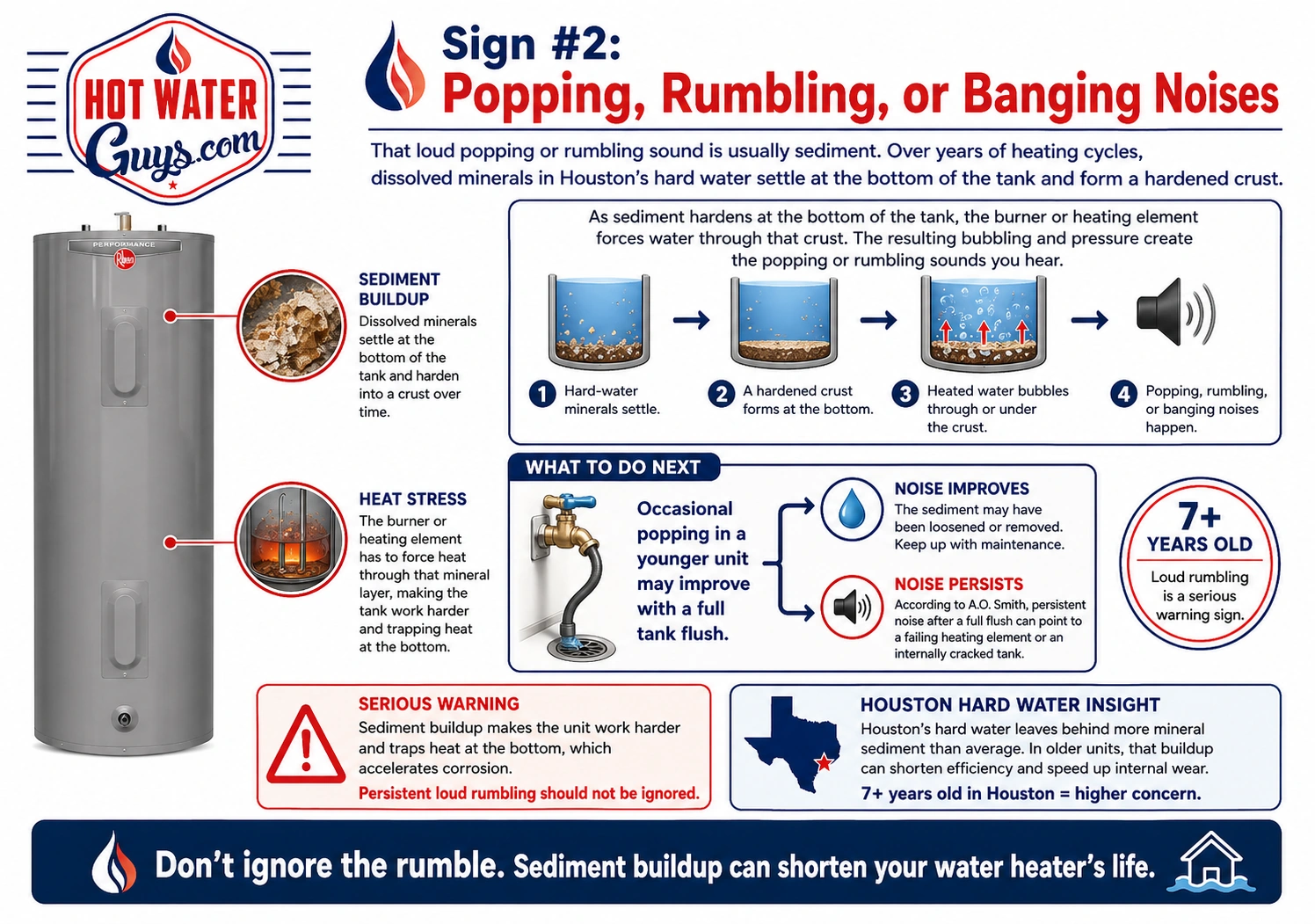
That loud popping or rumbling sound is sediment. Over years of heating cycles, dissolved minerals in Houston's hard water settle at the bottom of your tank and form a hardened crust. The heating element or burner forces water through that crust, creating the noise you hear.
Sediment buildup does two things: it forces your water heater to work harder to heat water through the mineral layer, and it traps heat at the bottom of the tank, accelerating corrosion. According to A.O. Smith, if the noises persist after a full tank flush, the heating element may be failing or the tank itself may be cracked internally.
Occasional popping in a younger unit is manageable with a flush. Persistent, loud rumbling in a unit over seven years old in Houston is a serious warning sign.
Sign #3: Your Water Heater Is Over 10 Years Old (7-10 in Houston)

Age is the most reliable predictor of failure. A.O. Smith puts the average tank water heater lifespan at 6-8 years. In Houston, hard water shortens that range to 6-8 years.
You can find your water heater's age in the serial number on the label. Most manufacturers encode the year and month of manufacture in the first four characters. If your unit is past the 10-year mark and showing any other signs on this list, you're operating on borrowed time.
The math is simple: a repair on a 12-year-old unit buys you 12-18 months before the next failure. A new unit gives you another decade of reliable hot water. Most repairs on aging units are not worth the cost.
Sign #4: Puddles or Moisture Around the Base

This is the sign most homeowners dismiss as condensation. It's rarely condensation. A puddle at the base of your water heater means the tank is leaking, and a leaking tank is an emergency.
If that's what you're looking at right now, skip to the phone: our same-day water heater replacement crew covers most of Greater Houston before evening.
Steel tanks expand and contract with every heating cycle. Over time, that thermal stress creates micro-fractures in the metal. Those fractures grow. A small seep today becomes a slow drip, then a steady leak, then a catastrophic tank failure that can dump 40-50 gallons of scalding water into your home.
Check the inlet and outlet connections first. A loose fitting or a dripping pressure relief valve discharge pipe can mimic a tank leak. If those connections are dry and you still see water pooling, the tank itself is failing. Call for an assessment before the situation escalates.
Sign #5: Inconsistent Water Temperature
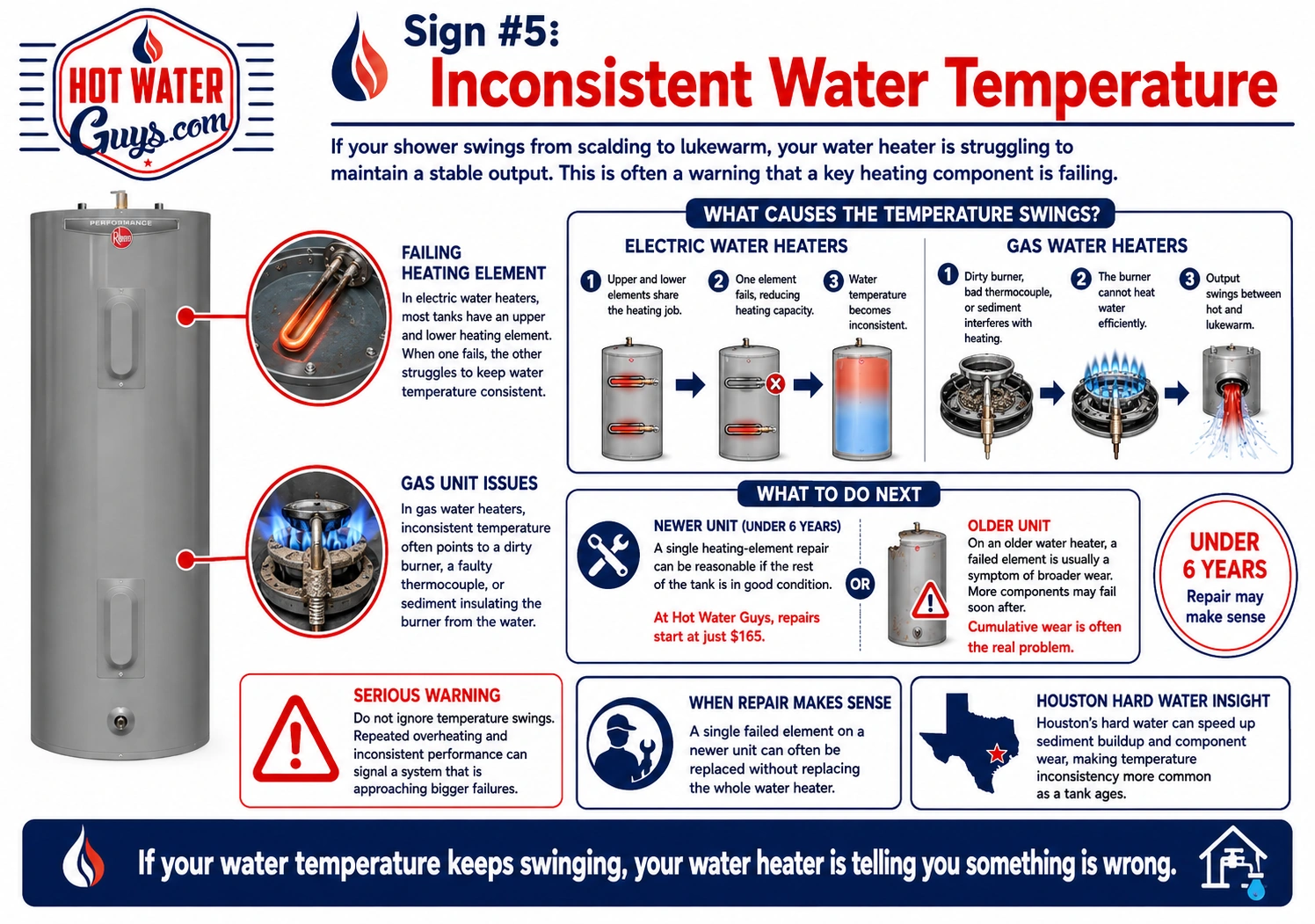
You start a shower at the right temperature, then the water swings unpredictably between scalding and lukewarm. This is not a thermostat problem you can ignore.
In electric water heaters, inconsistent temperature usually points to a failing heating element. Most electric tanks have two elements, one upper and one lower. When one fails, the other struggles to compensate. In gas units, the issue is typically a faulty thermocouple, a dirty burner, or sediment insulating the burner from the water.
A single heating element replacement on a newer unit (under 6 years) is a reasonable repair. At Hot Water Guys, repairs, including water heater repair in Spring, start at just $165. On an older unit, that failing element is a symptom, not the root cause. The underlying issue is usually cumulative wear, and more components will follow.
Sign #6: Rising Energy Bills With No Obvious Cause

Water heating accounts for roughly 18% of the average home's energy use, according to the U.S. Department of Energy. When your water heater is failing, that share climbs.
Sediment buildup forces the heating system to run longer to reach target temperature. Failing components cause the unit to cycle more frequently. A deteriorating tank loses heat faster, triggering additional heating cycles throughout the day. All of that shows up on your CenterPoint bill.
If your energy costs are creeping up and nothing else in your home has changed, check your water heater. An aging, sediment-clogged tank is often the culprit. The inefficiency compounds every month you delay replacement.
Sign #7: Visible Corrosion on the Tank or Fittings

Walk over to your water heater right now. Look at the tank body, the inlet and outlet connections, and the base. Any orange staining, rust streaks, or white mineral deposits around connections are signs the unit is deteriorating on the outside, which means it's almost certainly worse on the inside.
Corrosion on the fittings is sometimes addressable with a fitting replacement. Corrosion on the tank body itself is not. Once the steel exterior starts rusting, the structural integrity of the tank is compromised. You're looking at a replacement, not a repair.
Houston's high humidity adds an external corrosion factor that cooler, drier climates don't have. Units in garages or exterior utility rooms are especially vulnerable to accelerated surface rust.
Sign #8: You're Running Out of Hot Water Faster Than Usual
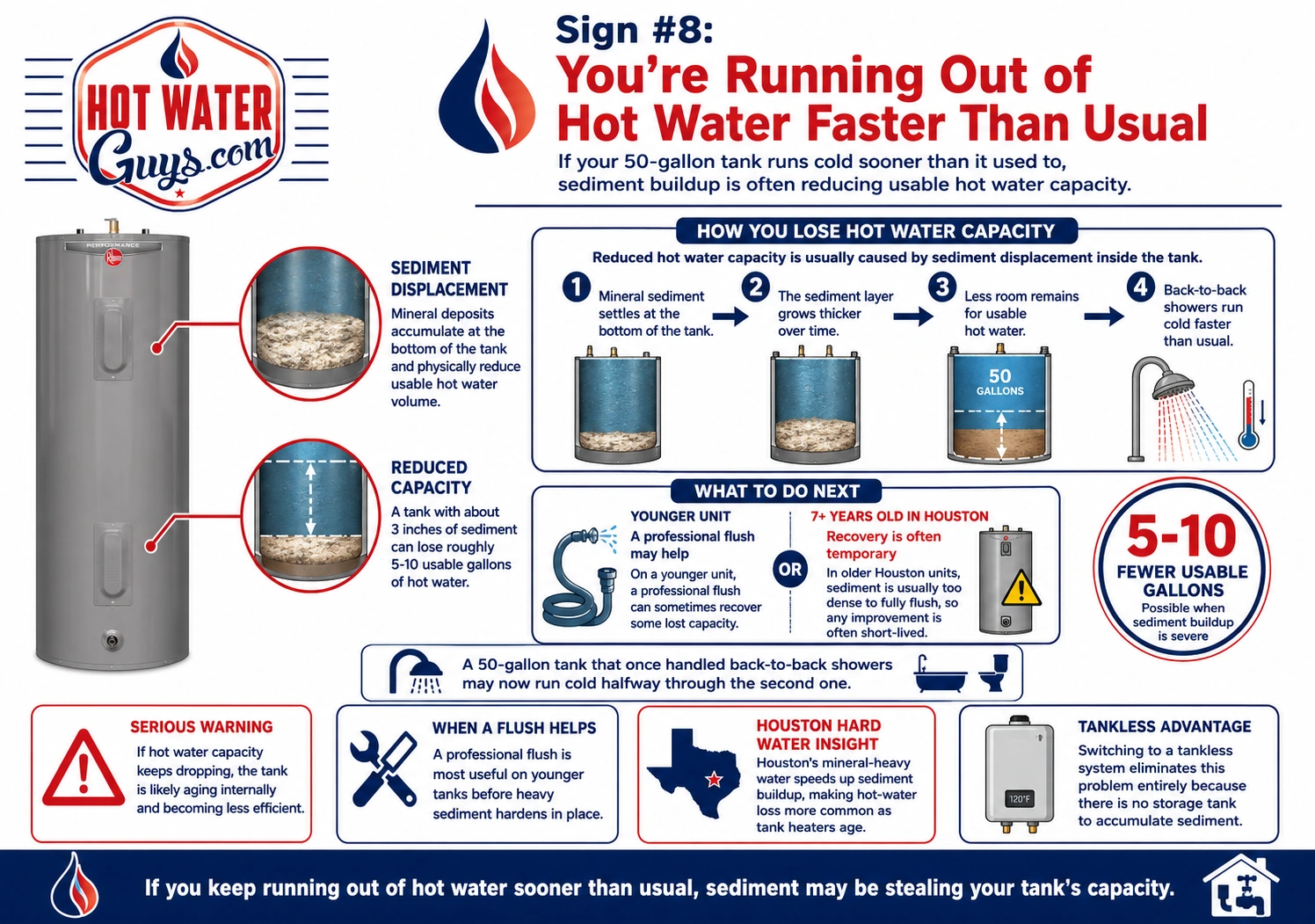
Your household hasn't changed. You haven't added new appliances. But your 50-gallon tank that used to handle back-to-back showers now runs cold halfway through the second one.
Reduced hot water capacity is almost always caused by sediment displacement. As mineral deposits accumulate at the bottom of the tank, they physically displace water volume. A tank with three inches of sediment at the bottom effectively has 5-10 fewer usable gallons of hot water than its rated capacity.
A professional flush can sometimes recover capacity in a younger unit. In a unit over seven years old in Houston, the sediment layer is typically too dense to fully flush, and the recovery is temporary. Switching to a tankless system eliminates this problem entirely since there's no tank to accumulate sediment.
Repair or Replace? Here's How to Decide
The decision comes down to three factors: age, the type of failure, and the cost of repair relative to replacement.

The 50% Rule
If a repair quote exceeds half the cost of a new unit, replacement wins every time. A new tank water heater installed at Hot Water Guys starts at $2,500. A tankless system starts at $4,200 installed, which is well below the $6,000+ most Houston plumbers charge. Both deliver better long-term value than repeated repairs on a failing unit.
Any repair over $500-600 on a unit approaching the end of its Houston-adjusted lifespan is money spent toward a replacement you will need in the next year or two regardless.
What About Permits and Costs in Houston?
Water heater replacements in Houston require a permit. The City of Houston charges a minimum permit fee of approximately $131 (a $97.56 base fee plus $33.56 administrative fee). Any legitimate licensed plumber will pull this permit for you. If a contractor quotes you a replacement without mentioning a permit, that's a red flag.
CenterPoint Energy currently offers rebates to help offset replacement costs: $50 for qualifying tank water heaters and $250 for qualifying tankless systems. Ask your installer about current program availability and whether your chosen equipment qualifies.
When to Call Right Now
Some signs on this list can wait a week for a scheduled appointment. These cannot:
- Water pooling at the base of the tank
- Visible cracks or bulging on the tank body
- Water that smells like sulfur or rotten eggs combined with rust-colored output
- No hot water combined with visible corrosion
- The pressure relief valve is dripping or visibly corroded
A failing tank can release 40-50 gallons of scalding water in minutes. The water damage alone, separate from the replacement cost, can run into thousands of dollars. If you're seeing active leaks from the tank body, shut off the cold water supply to the unit and call immediately.
The Bottom Line on Water Heater Replacement Signs
Most Houston water heaters signal their failure months before the final breakdown. Rusty water, sediment noise, puddles, and climbing energy bills are not quirks to live with. They're a countdown.
Houston's hard water means your unit has a shorter window than the national average. A 10-year-old water heater elsewhere is an 8-year-old water heater in terms of wear here. If your unit is showing two or more signs from this list, the conversation has shifted from repair to replacement.
Contact Hot Water Guys for a same-week water heater assessment. Our licensed technicians diagnose the issue, give you a straight answer on repair versus replacement, and handle everything from permits to installation.
related service
Request your free quote.
.webp)
related service area
