

The short answer: 1/6 or 1/5 HP, about 4 GPM
A tankless water heater cleaning pump is a small submersible or utility pump, typically 1/6 or 1/5 HP, that circulates descaling solution through your water heater to remove mineral buildup. The two specs that matter:
| Spec | What to buy | Why it matters |
|---|---|---|
| Horsepower | What to buy 1/6 or 1/5 HP | Why it matters A higher-horsepower pump, like 1/4 HP, would likely move the descaler too fast to clean well. |
| Flow rate | What to buy Around 4 GPM | Why it matters Research indicates manufacturers like Rinnai recommend around 4 GPM. Skip pumps rated 20-29 GPM. |
- What's in a kit: the pump, a bucket (3-5 gallons), hoses (usually 1/2" diameter, 6 feet long) and sometimes descaling solution.
- Cost: $100-$200 for a complete kit, or $40-$60 if you buy the components separately.
- When to use it: at least once a year, more often if you have hard water.
Rather skip the bucket-and-hose afternoon? Our professional tankless flush service in Houston runs $195, takes about an hour and includes a full safety inspection.
Why hard water makes the pump necessary
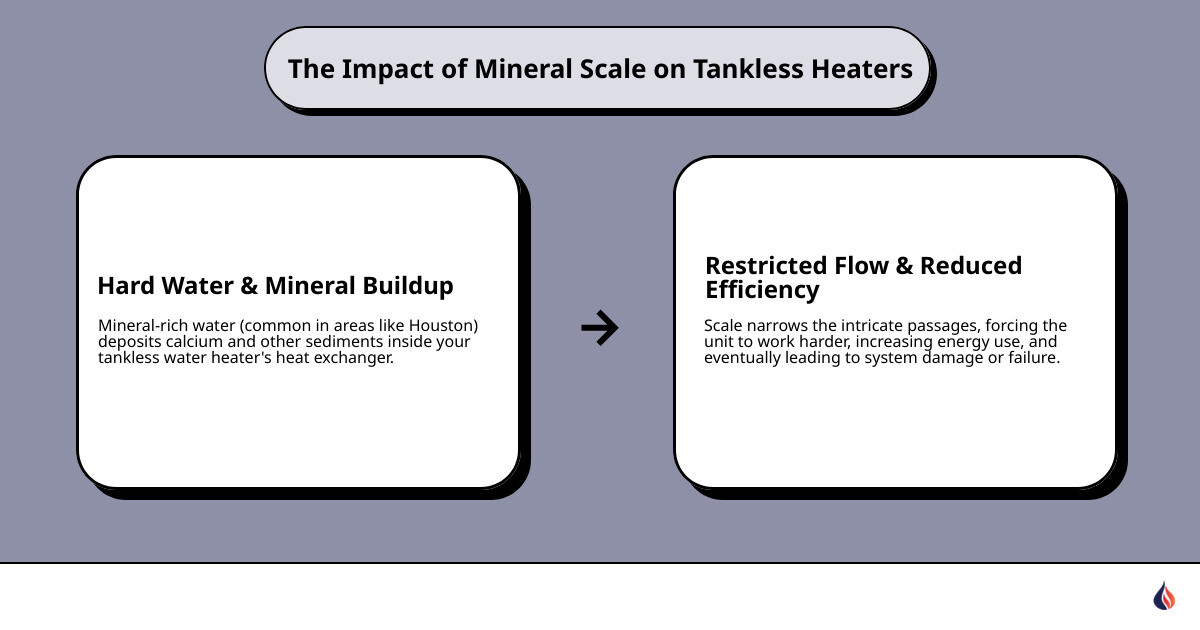
If you live in the Houston area, you already know about hard water. The mineral-rich water that leaves spots on your dishes does the same thing inside your tankless water heater, coating the heat exchanger with calcium and other deposits. Over time, that scale restricts water flow, forces your heater to work harder and can eventually lead to complete failure. The solution is regular descaling with a cleaning pump.
You can simply drain a traditional tank water heater. A tankless system has a complex heat exchanger with narrow passages, so you need a pump to create a closed loop that circulates descaling solution through those passages for 30 minutes to 2 hours, dissolving the mineral buildup.
Here's the catch: the wrong pump can make the problem worse. A pump that's too powerful pushes the solution through too quickly, giving it no time to work. A pump that's too weak won't create proper circulation.
I'm Tom Massimin, co-founder of Hot Water Guys, and I've been installing and maintaining tankless systems since 1998, long before most plumbers in Houston even knew what they were. Knowing the right tankless water heater cleaning pump specifications has been critical to keeping these systems running efficiently in our hard water.
Pump types, flow rate and horsepower
A tankless water heater cleaning pump is an essential tool for keeping your tankless water heater efficient and long-lived. Pumps come in a few variations, but they all do the same core job: circulate descaling solution through the appliance to break down mineral buildup.
Submersible vs transfer pumps. The two most common types are submersible utility pumps and transfer pumps. A submersible pump sits directly in the bucket of descaling solution. A transfer pump typically sits outside the bucket, with an intake hose drawing the solution in. For tankless descaling, a submersible circulation pump is generally recommended, because it makes a closed-loop system easy to set up.
Cost. The features that matter are gallons per minute (GPM), horsepower (HP) and hose compatibility. A suitable pump costs $40-$60 on its own, or around $110-$200 as a complete kit with the pump, hoses and a bucket. That's significantly less than hiring a plumber, which can cost anywhere from $100 to $600 for a single flush.
Flow rate (GPM). GPM measures how quickly the pump moves liquid, and for descaling you don't want an excessively high GPM. If the solution moves through the heat exchanger too fast, it doesn't get enough contact time to dissolve the mineral buildup. Research indicates that manufacturers like Rinnai recommend a circulation rate of around 4 GPM for cleaning. Many general-purpose submersible pumps are rated much higher, sometimes up to 25 GPM or even 29 GPM at 5 feet of head, and that disparity can lead to ineffective cleaning.
Horsepower (HP). HP indicates the power of the pump's motor, and the recommended horsepower for this job is low: ideally 1/5 HP or 1/6 HP. Our experience, and the findings of many experts, suggest a higher-horsepower pump such as 1/4 HP would likely move the descaling agent too fast to clean adequately.
The risks of a too-powerful pump.
- Ineffective cleaning. The primary risk: the solution rushes through without enough time to react with and dissolve the scale, so you go through the motions without getting results.
- Potential for damage. It's rare, but an extremely powerful pump creating excessive pressure could put undue strain on the delicate internal components. The heat exchanger's intricate pathways are designed for specific flow rates, and forcing liquid through them at much higher pressures could theoretically lead to issues.
- Wasted descaler. If the solution isn't given time to work, you may use more descaling agent or need to repeat the process more often, which raises your maintenance cost and effort.
The goal is an optimal circulation speed: fast enough to move the solution consistently, slow enough for the chemical reaction to happen. A 1/5 HP or 1/6 HP pump circulating at around 4 GPM strikes that balance best.
What to look for in a kit
To keep descaling straightforward, many homeowners buy a dedicated tankless water heater cleaning pump kit. Kits typically contain all the components needed for a successful flush. Look for:
- Submersible pump. The heart of the kit, ideally a 1/5 HP or 1/6 HP utility or sump pump, for the right power and flow rate without being too aggressive.
- Hoses. You'll need two, typically 1/2" diameter and around 6 feet long. Look for durable, flexible PVC hoses with washers, or better, stainless steel braided hoses for longevity and kink resistance. They connect the pump to your water heater's service valves and complete the circulation loop back to the bucket.
- Bucket. A 3- to 5-gallon pail is standard. It holds the descaling solution and serves as the pump's reservoir. Some kits even include a lid opener.
- Descaling solution. Some kits include a small amount, but you'll often need to buy it separately.
- Adapters and fittings. Make sure the kit includes any adapters needed to connect the hoses securely to your tankless water heater's service valves, which are typically 3/4" connections.
A well-equipped kit gives you all the right pieces from the start. For an example of what goes into proper tankless water heater maintenance, see our maintenance service.
Can a general-purpose submersible pump do the job? It's a common question from homeowners looking to save a few dollars. It's tempting to grab any submersible pump you have lying around, but a pump designed for this task is highly recommended. Many standard submersible pumps, especially those rated 1/4 HP or higher, are often designed for emptying flooded basements or draining pools, and they frequently boast 25 GPM or more. That's usually too aggressive for descaling: the solution blasts through the heat exchanger and loses the contact time it needs.
Pumps in dedicated tankless flushing kits are chosen for their lower horsepower (1/5 HP or 1/6 HP) and more appropriate flow rates (around 4 GPM). They create a gentle, steady circulation that gives the descaling solution ample time to dissolve mineral deposits without stressing the system.
The key is matching the pump's specs to the manufacturer's descaling recommendations. If your manual suggests a specific cleaning flow rate, such as 4 GPM for Rinnai units, you need a pump that can reach that rate without exceeding it significantly. The heat exchanger's internal resistance will reduce the pump's open-flow GPM, but starting with a lower-rated pump is always safer.
A general-purpose pump may seem cheaper at first, but if it doesn't clean effectively, you'll waste descaling solution and time, and you could shorten the life of your tankless unit. A proper cleaning pump or kit means effective maintenance, which translates into long-term savings on energy bills and potential repairs. A general-purpose pump can technically move liquid, but it's unlikely to descale optimally, so we always advise a pump with specifications suited to tankless water heater maintenance.
Gather your supplies and pick a descaler
Descaling with a cleaning pump is a systematic process that cleans thoroughly and prevents damage. The core idea is a closed loop: the descaling solution circulates continuously through your water heater's heat exchanger.

That closed-loop circulation is crucial, because it lets the descaling agent contact the mineral buildup again and again, slowly dissolving it. Once circulation is complete, a flush with clean water removes any leftover solution and loosened deposits. This regular maintenance is vital for preventing larger issues that might need extensive water heater repair.
Before you begin, gather everything. Being prepared makes the process smoother and safer:
- Tankless water heater cleaning pump: ideally a 1/5 HP or 1/6 HP submersible pump.
- Two hoses: approximately 6 feet long, 1/2" or 3/4" diameter, with the right fittings for your service valves.
- 5-gallon bucket: to hold the descaling solution.
- Descaling solution: commercial or vinegar (see below).
- Safety gear: chemical-resistant gloves and safety goggles are a must when handling descaling solutions.
- Adjustable wrench or pliers: for connecting and disconnecting hoses.
- Old towels: for drips and spills.
Commercial descaling solution. Many brands make descaling agents specifically for tankless water heaters. They're typically more potent and work faster than household alternatives. Always check compatibility with your specific model.
Food-grade white vinegar. A more natural and often more affordable alternative. With vinegar, you'll typically circulate longer, 1.5-2 hours, compared with 30-60 minutes for commercial solutions. Check your water heater's manual to make sure vinegar is an approved cleaning agent. We always recommend a product formulated for tankless water heaters. Important: if you use white vinegar, don't let it sit. Swap it out every 10 minutes throughout the entire flush. Vinegar loses its effectiveness after about 5 minutes of contact with your system, because the calcium buildup in your lines neutralizes the acid, and once that happens, the vinegar stops breaking down scale and is essentially just water circulating through your unit.
Whatever you choose, prioritize compatibility with your tankless water heater. Some aggressive chemicals can damage internal components, so stick to products labeled for tankless descaling or follow your manufacturer's recommendations.
Run the flush, step by step
With your pump and supplies ready, you can start. Safety first.
- Shut off power and gas. Turn off the electricity to your tankless water heater at the breaker and, for a gas unit, turn off the gas supply. That keeps the unit from firing during cleaning and keeps you safe.
- Shut off the water supply. Turn off the hot and cold water isolation valves on the unit. Then close the service valves, usually on the purge/flush kit below the main isolation valves, and remove their caps.
- Drain the unit (optional but recommended). Put a small bucket or towel under the service valves, since some water may drip. Open the purge valves (the small knobs on the service valves) to let residual water in the heat exchanger drain, which also helps clear loose sediment before circulation begins.
- Prepare the descaling solution. Pour the recommended amount of descaling solution, or 2-3 gallons of white vinegar, into your 5-gallon bucket.
- Connect the hoses. Connect one hose from the pump's discharge side to the cold water service valve on your tankless unit, and connect the second hose to the hot water service valve.
- Submerge the pump and complete the loop. Place the pump in the bucket, fully submerged in the solution, and put the free end of the hot-side hose back into the bucket. You've now created a closed loop.
- Open the service valves. Open both the hot and cold water service valves you connected the hoses to.
- Circulate the solution. Plug in the pump. You should see the solution begin circulating through the hoses and into the water heater.
- Let it run. Most commercial descaling solutions need 30-60 minutes; white vinegar usually needs 1.5 to 2 hours. If the solution in the bucket changes color significantly, from clear to murky or green, the descaling is working. Using vinegar? Swap it out every 10 minutes, as described above.
- Stop and disconnect. Unplug the pump. Close the cold water service valve first, then the hot. Carefully disconnect the hoses from the service valves, and expect some drips.
- Flush with clean water. Dispose of the used solution responsibly. Reconnect the cold water hose to the cold water service valve and put its other end in the empty bucket. Open the main cold water isolation valve (not the service valve) and let clean water flush through into the bucket for 3-5 minutes, or until it runs clear and you're confident all the descaling solution is gone.
- Restore the system. Close the cold water service valve, remove the hose and replace the caps on both service valves. Open both main hot and cold water isolation valves.
- Restore power and gas. Turn the electricity back on at the breaker and open the gas supply valve, if applicable.
- Test the system. Run a hot water tap for several minutes to purge air from the lines and confirm the water heater is working correctly. Check for leaks around the service valves.
One more note: if a flush uncovers an error code or a failing component, that's a job for our tankless repair specialists. More descaler won't fix it.
Safety, schedule and pump care
Maintaining your tankless water heater with the right cleaning pump is about safety and a longer appliance life as much as efficiency. Follow the safety protocols, keep a regular schedule and look after your equipment, and every flush goes smoothly.

Critical safety precautions.
- Turn off electricity and gas. Always disconnect power at the circuit breaker and shut off the gas supply, if applicable, before you start. That prevents accidental activation and eliminates electrical and fire hazards.
- Wear gloves and goggles. Descaling solutions, commercial or vinegar, are acidic and can irritate skin and eyes. Chemical-resistant gloves and safety goggles are non-negotiable.
- Ventilate. Some descaling solutions produce fumes. Work in a well-ventilated area, or open windows and use a fan indoors.
- Handle solutions with care. Follow the manufacturer's mixing and handling instructions, avoid splashing, and keep solutions away from children and pets.
- Use grounded outlets. Plug the pump into a grounded (three-prong) outlet. Never use extension cords that aren't rated for outdoor or wet conditions, and keep your hands dry when handling the plug.
- Prevent spills. Lay old towels or a tarp around the work area and clean up any spills immediately.
- Let the unit cool. If the water heater has been in use recently, let it cool before you begin so you aren't working with hot components.
How often to descale. Frequency depends mostly on your water hardness. The general recommendation, and the commonly accepted one, is to flush at least once a year. This helps prevent significant mineral buildup that can reduce efficiency and lifespan. The harder your water, the more calcium and magnesium it carries, and the faster scale accumulates. Areas with particularly hard water, like much of Houston, Bellaire, Missouri City and other surrounding communities we serve, may need more frequent cleaning. If you're unsure of your local hardness, check with your municipal water provider or use an online tool to check water hardness by zip code. In many parts of Houston, we find semi-annual (every six months) descaling helps maintain peak performance.
Between scheduled cleanings, watch for signs your tankless water heater needs a flush:
- Reduced hot water flow: scale restricts the internal passages, so less water comes out.
- Fluctuating water temperature: the heat exchanger may be working inefficiently because of scale.
- Error codes: some advanced units display flow or heating error codes caused by scale.
- Longer heating times: scale could be insulating the heating elements.
Know your water quality and watch your unit's performance, and you can tailor a descaling schedule that keeps it running well for years.
Caring for the pump. After each descaling session, rinse the pump by running it for a few minutes in a bucket of fresh water, which removes leftover solution that could corrode internal parts. Then disconnect it and let it air dry completely before storing, since moisture can cause rust or mildew, especially in electrical components. Store it somewhere dry and temperate, away from extreme heat or cold, ideally in its original box or a dedicated container to keep out dust and avoid damage. Before and after each use, inspect the pump, hoses and cord for wear, cracks or damage, and replace anything compromised immediately. Simple care prolongs the pump's life and keeps it reliable.
A cleaning pump is a vital part of keeping a tankless water heater healthy. Regular descaling improves efficiency, extends the unit's life and keeps the hot water consistent. Without it, the hard water in places like Houston, Bellaire and Sugar Land would quickly choke your system with mineral buildup, leading to costly repairs or premature replacement. For homeowners in Sugar Land, Katy and other hard water areas, regular maintenance is the key to your tankless water heater's full potential and longevity. DIY descaling with the right pump is an option, but for guaranteed results and peace of mind, trust the experts. Hot Water Guys has over 20 years of experience with the Houston area's unique water challenges, and we make sure your system is flushed correctly and safely every time. Schedule your professional tankless water heater maintenance today, and let us keep your tankless water heater running like new.
Common questions
What happens if I use a pump that is too powerful?
A pump with excessively high GPM or HP can circulate the descaling solution too quickly, preventing it from effectively dissolving the mineral buildup. In rare cases, extreme pressure could potentially strain internal components, though the primary issue is reduced cleaning effectiveness.
How long should I run the cleaning pump?
Most commercial descaling solutions recommend circulating for 30-60 minutes. With white vinegar, a longer 1.5 to 2 hours is often suggested, and you should swap out the vinegar every 10 minutes throughout the flush. Vinegar loses its effectiveness after about 5 minutes of contact with your system, because the calcium buildup neutralizes the acid. Always follow the instructions on your descaling solution for the most accurate timing.
Can I clean a tankless water heater without a pump?
Technically yes, with gravity-fed methods, but it's highly inefficient and not recommended. A pump creates the continuous, pressurized loop needed to circulate the cleaning solution through the heat exchanger's intricate pathways and flush out the mineral deposits.
How often should I descale a tankless water heater in Houston?
At least once a year, and more often with hard water. In many parts of Houston, we find that semi-annual (every six months) descaling helps maintain peak performance.